reserve fund study
Reserve Fund Studies in Alberta: What Buyers Need to Know (2026)
The reserve fund study is the single most important document in a condo package, and the hardest to read. Here is what Alberta law requires, how to judge whether a fund is healthy, and the warning signs that a special assessment is coming.
 Leanna Vinogradov
Ask anyone who reviews condo documents for a living which document matters most and you will get the same answer: the reserve fund study. It is the closest thing a building has to a medical chart, a long-range forecast of every major repair the corporation will face and whether there will be money to pay for it.
It is also, by a wide margin, the hardest document in the package for a buyer to read. This guide explains what a reserve fund study is, what Alberta law requires, how to judge whether a fund is actually healthy, and the warning signs that a special assessment is hiding in the numbers.
What a reserve fund actually pays for
Every Alberta condominium corporation runs on two pools of money:
- The operating fund covers the predictable, recurring costs: landscaping, cleaning, management fees, utilities, insurance premiums.
- The reserve fund covers the big, infrequent capital work: replacing the roof, modernizing the elevators, repairing the parkade membrane, redoing the building envelope, repaving the lot.
Your monthly condo fees feed both. The reserve fund exists so that when the roof reaches the end of its life, the money is already sitting in the account, contributed gradually by every owner who enjoyed that roof over the decades. When it works, nobody gets a surprise bill. When it does not, the shortfall lands on whoever owns a unit at the time, which is exactly the risk a buyer needs to evaluate.
What Alberta law requires
Reserve funds in Alberta are governed by the Condominium Property Act and its regulation, and the requirements form a repeating cycle:
- A reserve fund study at least every five years, prepared by a qualified person, covering the parts of the property the corporation must repair or replace over the long term.
- A reserve fund plan, approved by the board, describing what work the study anticipates and how the corporation will pay for it.
- An annual report to owners on the fund: the balance, contributions collected, and what was spent.
Two things are worth underlining. First, the law requires a process, not a funding level; there is no statutory minimum balance an Alberta reserve fund must hold. A corporation can be fully compliant on paper while sliding toward a serious shortfall. Second, the study, the plan, and the annual report are all documents you are entitled to see as a buyer. They belong in every complete document package, alongside the financials, bylaws, and minutes on our Alberta document list.
How to read a reserve fund study
A reserve fund study is a 30-year projection built from dozens of moving parts. Here is one slice of a real one:
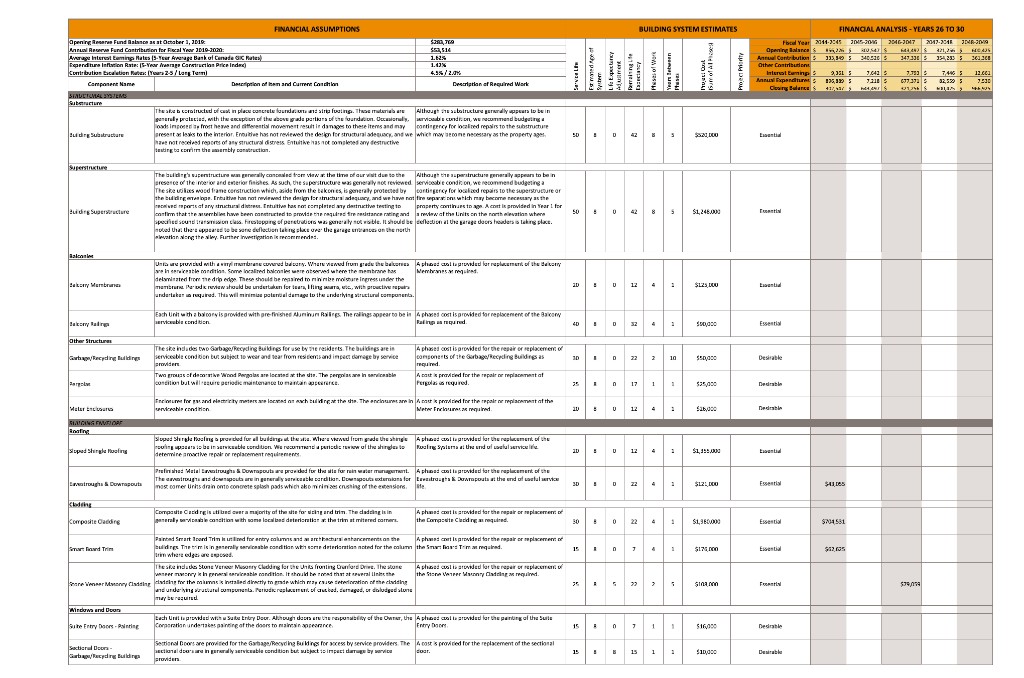
Three layers do the work:
1. The component inventory
Every major system gets a row: substructure, roofing, cladding, balconies, mechanical, elevators, parkade. For each, the study records a service life, an effective age (how worn it actually is, not just how old), the projected cost of repair or replacement, and when the work is expected to land.
2. The financial assumptions
Across the top sit the levers that drive the whole model: the annual contribution from owners, the rate at which contributions escalate, assumed interest earned on the fund, and an inflation index for construction costs. Small changes here compound dramatically over 30 years.
3. The year-by-year projection
The model rolls forward: opening balance, plus contributions and interest, minus expenditures, closing balance. The critical line is whether that balance stays comfortably above zero through the years when major projects hit.
The question a buyer needs answered is deceptively simple: does the actual fund balance today match what the study says it should be at this point in the plan? A fund that is far behind its own schedule is the clearest early warning a condo document can give you.
What "healthy" looks like
There is no single number that makes a reserve fund healthy, and be skeptical of anyone who quotes one. What adequate looks like depends on the building's age, size, and construction type: a 40-year-old concrete high-rise approaching envelope and riser work needs far more per unit than a five-year-old townhouse complex whose components are all mid-life.
Instead of hunting for a magic figure, look for alignment:
- The balance tracks the study. The actual account balance is at or near the study's projected balance for the current year.
- Contributions follow the plan. The board is collecting what the study called for, not quietly holding fees flat to keep the listing attractive.
- The study is current. It is less than five years old and, ideally, reflects any major work done since.
- The plan and the minutes agree. Projects the study scheduled are actually being discussed, tendered, and completed on time.
That last point is why the study never gets read in isolation. A healthy-looking projection means little if two years of board minutes show the roof replacement deferred twice and an engineering report nobody has funded.
The warning signs buyers miss
These are the patterns that separate a routine review from a five-figure surprise:
- A stale study. If the most recent study is pushing five years old or older, the costs in it are stale too, and construction inflation has been brutal. A corporation that is late commissioning its next study is often one that does not want to see the answer.
- A widening gap between plan and balance. Behind by a little is a conversation; behind by a lot is a special assessment in the making.
- Optimistic assumptions. An aggressive contribution-escalation rate, a low inflation index, or generous interest assumptions can make a weak fund look fine on paper. The projection holds together only if reality cooperates.
- Deferred components. Work the study scheduled for two years ago that keeps sliding right. Deferral does not make the roof younger; it makes the eventual bill bigger.
- Fees that look too good. A conspicuously low condo fee is often an underfunded reserve wearing a disguise. Compare the fee against what the reserve fund plan requires, not against other listings.
From shortfall to special assessment
When the reserve cannot cover a project that can no longer wait, the corporation has limited options: raise fees sharply, borrow (and service the loan through fees), or pass a special assessment, a one-time charge divided among owners by unit factor. Balcony remediation, parkade membranes, and building envelopes routinely produce assessments from a few thousand to well over $20,000 per unit.
The timing risk is what makes this a buyer's problem: if the assessment is approved after you take possession, you pay it, even though the shortfall built up over the previous decade. The warning signs were sitting in the study and the minutes the whole time. Our guide to special assessments in Calgary condos covers how these charges work in detail.
How CondoScan evaluates a reserve fund
Reserve adequacy is the core of every CondoScan review. We read the study and plan alongside the financial statements, annual reserve report, and years of meeting minutes, and we answer the questions that matter in plain language: whether the balance tracks the plan, whether the assumptions are realistic, what major work is coming and when, and how exposed you are to a special assessment.
You get an interactive report plus PDF within 24 hours of a complete document package, with unlimited follow-up questions before your condition deadline. Reviews start at $349 + GST; our Alberta price guide shows how that compares across providers. If you are buying in Calgary, you can get started here.
The bottom line
The reserve fund study is where a building's future repair bills are written down years in advance. Alberta law makes sure the study exists; it does not make sure the fund is adequate, and it does not read the study for you. Get the current study and plan in your document package, check the balance against the plan, read the minutes for what the numbers are not saying, and get expert eyes on all of it before you remove conditions.
Frequently asked questions
What is a reserve fund study?
A reserve fund study is a long-term financial and engineering forecast for a condo corporation. A qualified professional inventories the building's major components (roof, boilers, elevators, parkade, building envelope and more), estimates when each will need repair or replacement and at what cost, and projects whether the corporation's savings and contributions will cover those costs over roughly 30 years. In Alberta, it is the foundation for the corporation's reserve fund plan.
Are reserve fund studies required in Alberta?
Yes. Under Alberta's Condominium Property Act and its regulation, condominium corporations must obtain a reserve fund study from a qualified person at least every five years, prepare a reserve fund plan based on it, and report annually to owners on the fund. When you buy a resale condo, the current study and plan are part of the document package you should request and review before removing conditions.
How much money should a condo reserve fund have?
There is no legal minimum in Alberta and no single magic number. A healthy fund is one whose actual balance tracks what its own study says it should have at this point in the plan, given the building's age and upcoming projects. A 40-year-old tower approaching envelope work needs far more per unit than a five-year-old townhouse complex. The gap between the study's projected balance and the real balance matters far more than the raw dollar figure.
What happens if a reserve fund is underfunded?
The money for major repairs has to come from somewhere, so an underfunded reserve typically leads to sharp condo fee increases, a special assessment (a one-time charge that can run from a few thousand to well over $20,000 per unit), corporation borrowing, or deferred maintenance that makes the eventual repair more expensive. Buyers who take possession before a special assessment is approved can still be the ones who pay it.
Who reviews the reserve fund study before I buy?
That is your job as the buyer, during your condition period, and it is the hardest document in the package to interpret. Most buyers hire a professional condo document review service to assess reserve adequacy alongside the financials, minutes and bylaws. CondoScan reviews the full package, including the reserve fund study and plan, and delivers a plain-language report within 24 hours of receiving complete documents.
Related reading

June 12, 2026
The Risks of Reviewing Calgary Condo Documents Yourself
Reading the documents is easy. Interpreting them correctly before your Calgary condition deadline is where most buyers get burned. Here is what DIY reviewers miss, and what it costs.

July 10, 2026
Condo Document Review in Edmonton: A Buyer's Guide (2026)
Same Condominium Property Act, different buildings. Here is what Edmonton condo buyers need to know about reviewing documents before removing conditions, from ICE District towers to walk-ups in Oliver and complexes in St. Albert and Sherwood Park.

July 3, 2026
How Much Does a Condo Document Review Cost in Alberta? (2026 Price Guide)
A transparent, up-to-date look at what condo document reviewers actually charge across Calgary, Edmonton, and the rest of Alberta, with a side-by-side price comparison and the one number that matters more than price: turnaround.