condo board management Alberta
Condo Board Management in Alberta: A Guide to Governance
 CondoScan

Effective condo board management in Alberta means making sound decisions, watching the corporation's finances, planning for major repairs, and keeping records that clearly show what is happening. The elected board remains responsible for governing the corporation whether volunteers handle the administration themselves or a licensed condominium manager supports the work.
If you serve on a condo board, you already know the job is broader than most owners realize. In one meeting, you may be reviewing a budget variance, discussing a roof repair, answering an owner complaint, and deciding whether a contract should be renewed. Months later, a buyer may read the records from that meeting and try to understand what those decisions mean for the unit they are considering.
That is where good management and good documentation meet.
Through more than 500 Alberta condominium document reviews, CondoScan has seen how clear, current, and well-organized records can make the buyer review process easier to navigate. This guide explains the practical side of managing an Alberta condominium corporation and shows how the resulting records may be understood by owners, buyers, Realtors, and document reviewers.
CondoScan reviews condominium documents for buyers. It does not manage condominium corporations or provide legal, accounting, engineering, insurance, or property-management advice.
What is a condo board responsible for in Alberta?
An Alberta condo board governs the condominium corporation. It makes decisions, oversees the corporation's finances and property, maintains required records, and carries out the corporation's responsibilities under the Condominium Property Act, the Condominium Property Regulation, and the registered bylaws. A manager may handle day-to-day work, but the board remains responsible for governance and oversight.
In practical terms, the board is responsible for keeping the corporation moving in the right direction. That does not mean directors must personally perform every task. It means they need to understand what must be done, decide who should do it, and confirm that the work was completed properly.
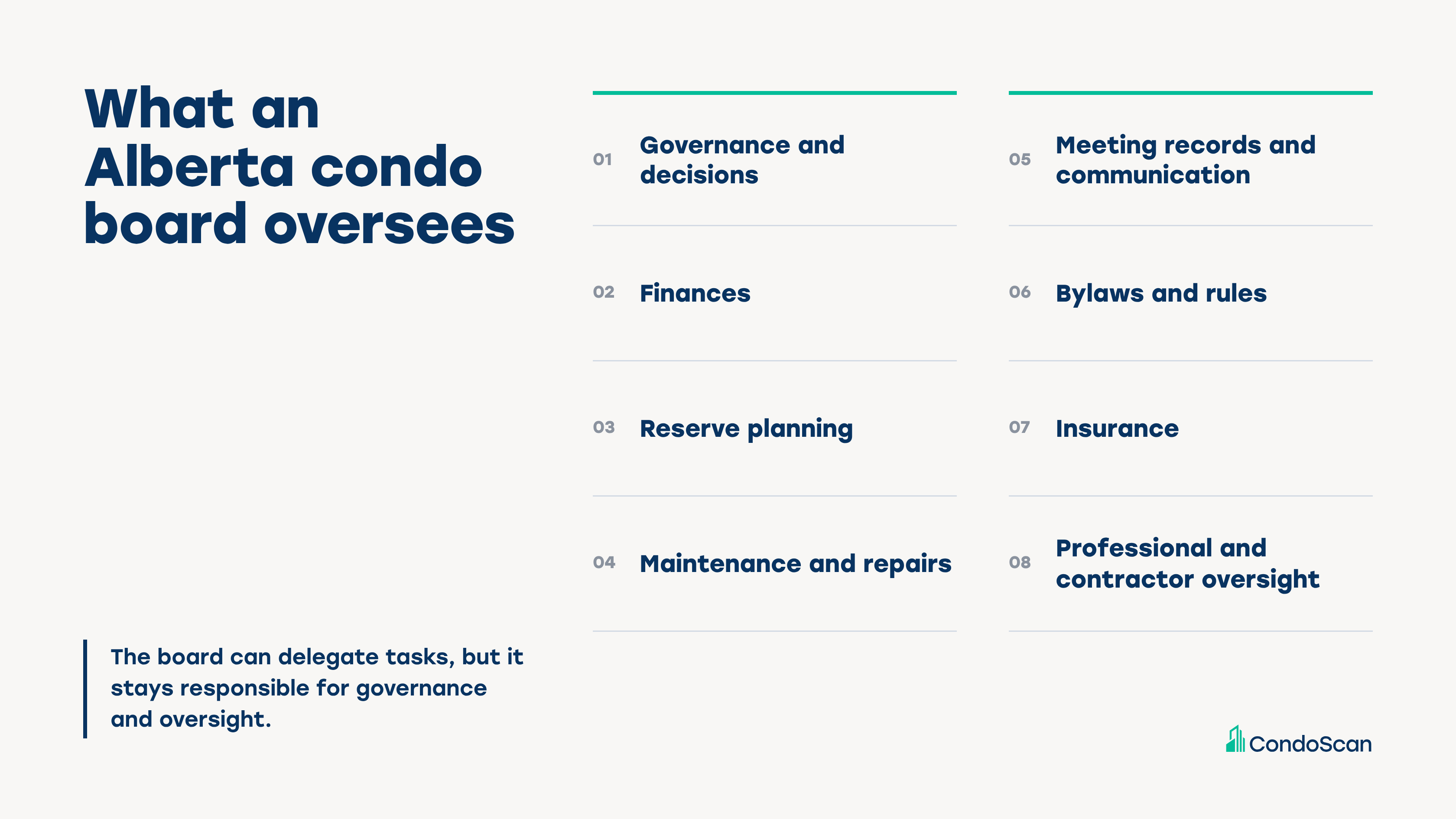
Governance and decisions
The board makes authorized decisions between general meetings, follows the Act and bylaws, documents resolutions, and brings matters to owners when owner approval is required.
A useful test is whether another director could look at the records six months later and understand what the board decided, why it mattered, and what was supposed to happen next.
Finances
The board approves the operating budget, sets condominium contributions, monitors income and expenses, oversees arrears, and reviews financial reporting. It also needs to understand how today's operating decisions may affect future fees, services, or repairs.
Reserve planning
Alberta condominium corporations must establish and maintain a capital replacement reserve fund. The corporation must obtain a reserve fund study at least every five years, and the board must prepare and approve a reserve fund plan based on that study. Required reserve fund information must also be reported to owners annually.
Maintenance and repairs
The board oversees the common property and other property for which the corporation is responsible. The exact division of responsibility depends on the Act, the condominium plan, and the bylaws. The board may rely on managers, contractors, engineers, and other professionals, but it should still understand the issue, the scope, the cost, and the approval process.
Insurance
The board oversees the corporation's required insurance, renewals, appraisals, deductibles, and claims. Because a claim or deductible can create significant costs for the corporation or an owner, specific questions should be directed to the corporation's insurance broker and, where needed, an Alberta condominium lawyer. CondoScan's Alberta condo insurance guide explains the difference between corporation coverage and the coverage a unit owner may need.
Bylaws and rules
The board administers the corporation's registered bylaws and valid rules. That includes communicating requirements, using a consistent enforcement process, and seeking legal advice when a restriction or sanction raises a difficult legal or human-rights question.
Meeting records and communication
The board arranges meetings, provides required notices, records decisions, and maintains the corporation's records. It also gives owners a clear way to ask questions, raise concerns, and submit requests.
Professional and contractor oversight
Hiring a professional does not mean the board can stop paying attention. The board should understand the scope, review important recommendations, approve material decisions, and monitor whether the corporation is receiving the work it contracted for.
How do Alberta condo management models differ?
An Alberta condominium corporation may manage its own affairs or hire licensed condominium management support. The difference is who performs the day-to-day work. In either model, the corporation is governed by its elected board.
This distinction matters because the words are often used loosely. A board president is not a separate type of condominium corporation. A property manager does not replace the board. A management company can take on substantial administrative responsibility, but it works for the corporation under an agreed scope.
The Real Estate Act does not require a condominium corporation to hold a condominium management licence when it manages its own affairs. A person or company providing condominium management services to others operates within Alberta's licensing framework. RECA describes condominium management licensees as overseeing the day-to-day operations of condominium corporations.
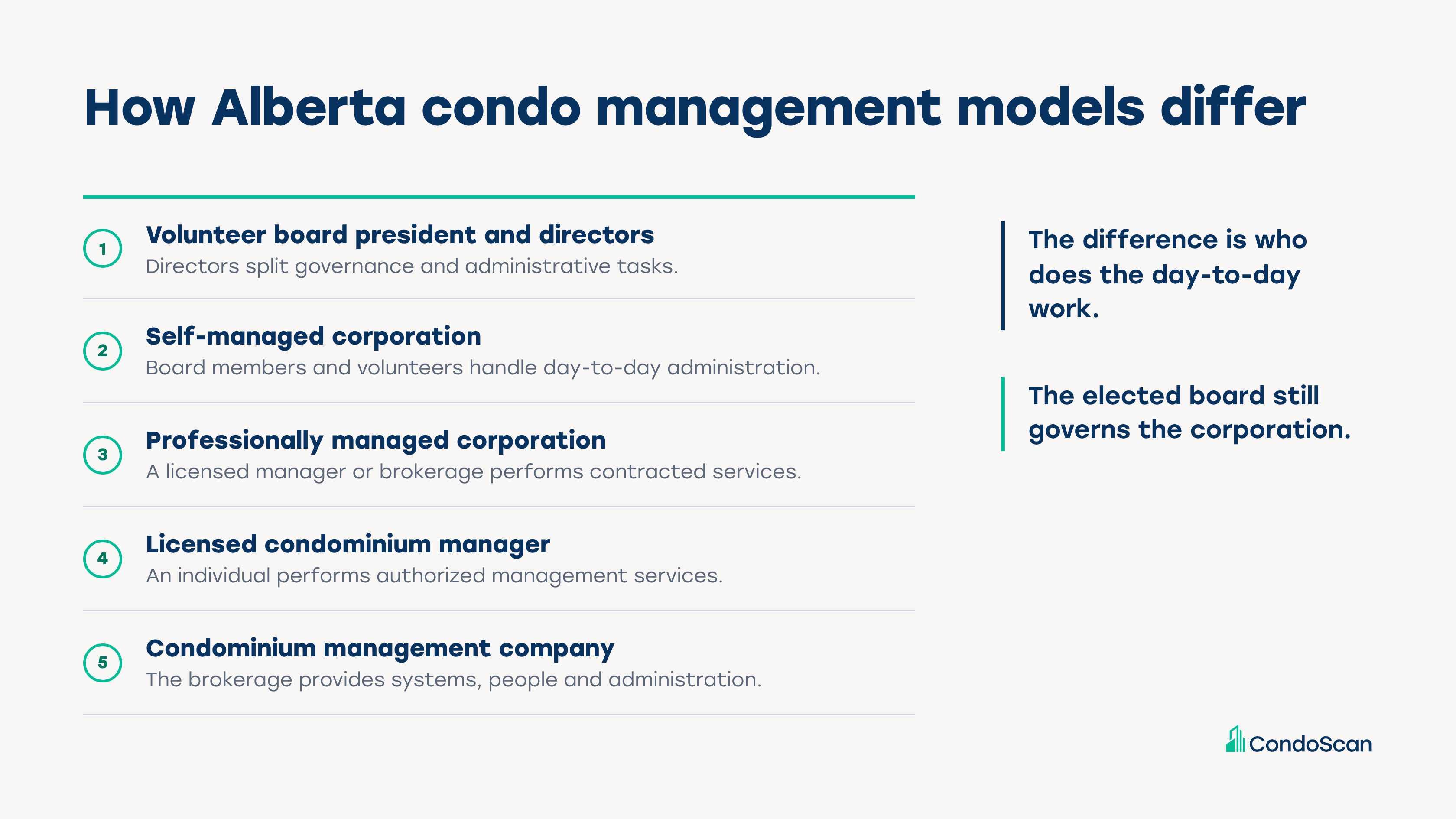
| Model or role | Who does the work? | What the board still owns | Common record challenge | Why buyer readiness matters |
|---|---|---|---|---|
| Volunteer board president and directors | Directors divide governance and administrative tasks | Decisions, approvals, oversight, and corporate records | Information may follow individual volunteers | A sale or transition should not depend on one person's inbox |
| Self-managed corporation | Board members and volunteers handle daily administration, sometimes with outside specialists | Governance and operational oversight | Capacity, continuity, and version control | A clear system helps the board respond consistently despite turnover |
| Professionally managed corporation | A licensed manager or brokerage performs contracted services | Direction, material approvals, and supervision | Records may be split between board and manager systems | Both sides should know where the authoritative file lives |
| Licensed condominium manager | The individual performs authorized management services | The board remains accountable for governance | Scope may be assumed instead of documented | Managers often receive buyer requests and need current approved records |
| Condominium management company | The brokerage provides systems, personnel, and administration | Contract selection, direction, and oversight | Offboarding and data handover may be unclear | A defined handover protects records when the relationship changes |
No model is automatically better. A small townhouse complex with engaged directors may self-manage effectively. A large building with elevators, complex mechanical systems, employees, and frequent projects may benefit from professional management.
How should an Alberta condo board organize its records?
A condo board should maintain one reliable source for current records, a clear archive of earlier versions, and sensible controls around confidential information. The system should continue working when directors, officers, managers, or vendors change.
If the only person who knows where the files are is the treasurer, the corporation does not really have a record system. It has a single point of failure.
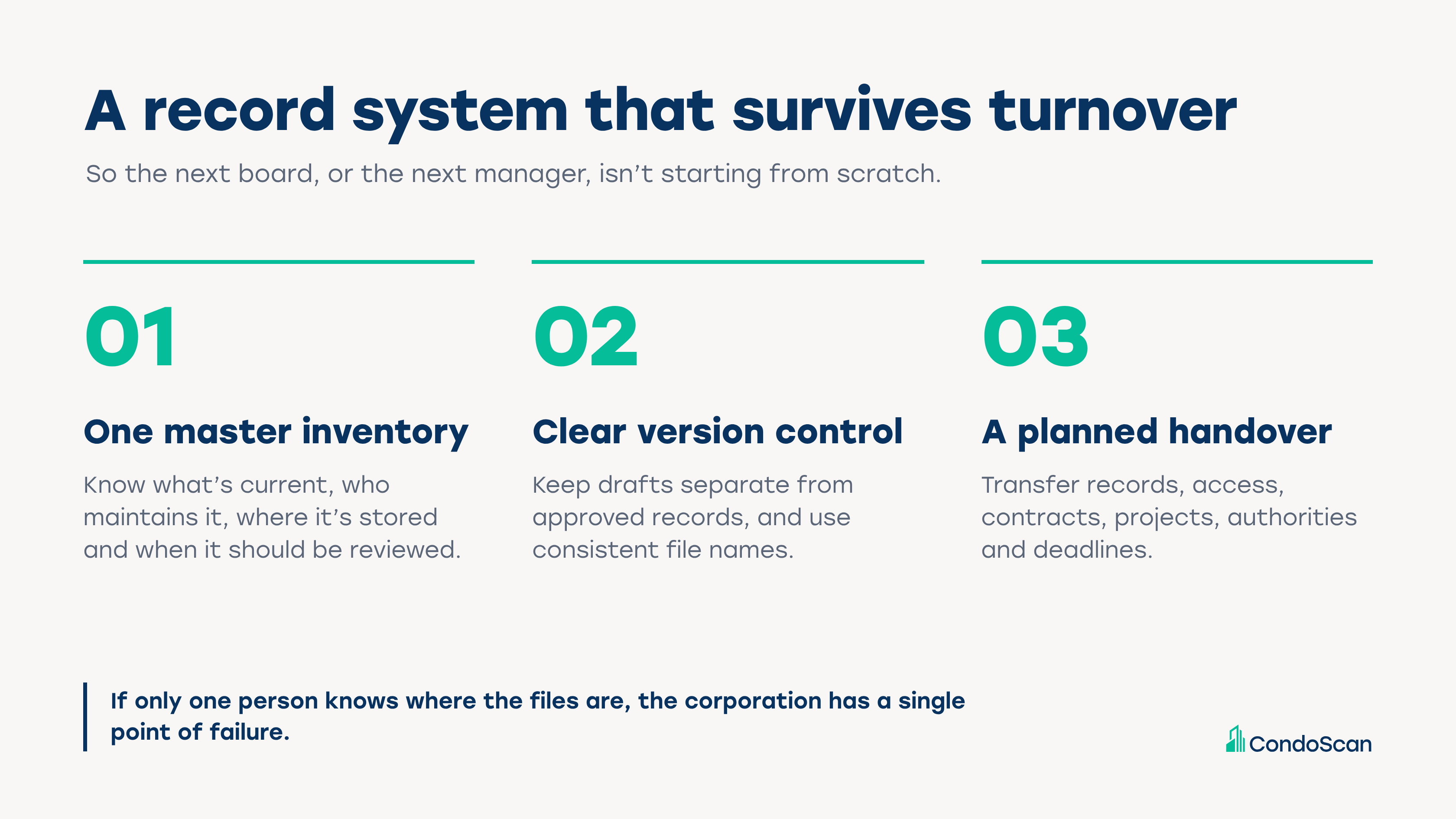
Start with one master inventory
Create a simple inventory showing:
- the document category
- the current or approved version
- the date of the document
- who is responsible for maintaining it
- where it is stored
- who may access it
- when it should be reviewed again
Use a secure corporation-controlled repository or a management platform with clear ownership and handover terms. Organize folders by category and year. Use consistent file names. Keep drafts separate from approved records. Alberta's guidance on personal information and condominium corporations is a useful starting point when setting access and disclosure controls.
| Document category | Why it matters | Who commonly maintains it | When it should be reviewed | What a buyer may learn from it |
|---|---|---|---|---|
| Condominium plan, title, and governing records | Define the legal project, units, and registered interests | Board, manager, lawyer, or Land Titles source | When registered changes occur | What is owned and which instruments govern |
| Bylaws and amendments | Establish governance and use restrictions | Board, manager, and lawyer | After every amendment and during periodic reviews | Rules involving pets, rentals, renovations, and responsibility |
| Board and general meeting minutes | Preserve decisions and important history | Secretary or manager | After approval and during the annual inventory | Projects, claims, disputes, and unresolved matters |
| Budgets and financial statements | Show planned and actual financial activity | Treasurer, manager, and accountant | Monthly or recurring review, and annually | Financial trends, deficits, and explanations |
| Reserve fund study, report, and plan | Connect future work with funding | Board, manager, and qualified provider | Study at least every five years; plan reviewed regularly | Whether projects and contributions appear aligned |
| Insurance information | Explains coverage, deductibles, and policy status | Board, manager, and broker | At renewal and after material changes or claims | Potential exposure and questions for the buyer's broker |
| Contracts and service agreements | Record price, term, obligations, and termination | Board or manager | Before renewal and after amendments | Long-term commitments or changing operating costs |
| Engineering, maintenance, and inspection reports | Document condition and recommendations | Board, manager, or specialist | When received and as recommendations are addressed | Known building issues and planned responses |
| Special assessment records | Record purpose, authority, amount, and status | Board, manager, and accountant | Whenever considered, approved, or changed | Current or potential additional owner costs |
| Unit, parking, and storage records | Support unit-specific administration | Board or manager | When ownership or assignments change | Rights connected to the unit |
| Document-request log | Shows who asked, what was sent, and when | Designated director or manager | With every request | Helps prevent missing or inconsistent packages |
Use clear version control
A file name should tell you what the document is, when it was created, and whether it is final. For example, 2026-09-18_Board-Minutes_Approved is more useful than "September Minutes Final FINAL 2".
Do not replace registered bylaws with an informal summary. Do not mix approved and draft minutes in the same folder without clear labels. Back up the repository and use multi-factor authentication where available.
Plan for the handover before you need it
Board and manager transitions are where weak record systems become obvious. Use a signed inventory to transfer:
- records and archives
- repository and software access
- banking and signing authorities
- contracts and renewal dates
- insurance contacts and active claims
- legal matters and collection files
- current projects and professional reports
- keys, access devices, and communication channels
- upcoming deadlines
Do not use a generic online retention period for all records. Alberta legal, accounting, insurance, privacy, and litigation requirements may differ by document and circumstance. A formal retention schedule should be reviewed by appropriate professionals.
What financial information should a condo board monitor?
A board should understand whether the corporation can cover current expenses, follow its approved budget, and fund the major work ahead. No single number tells the whole story.
A large reserve fund balance may look reassuring until you compare it with a major project due next year. A temporary operating deficit may look alarming until you learn it resulted from one unusual expense that has already been addressed. Context matters.
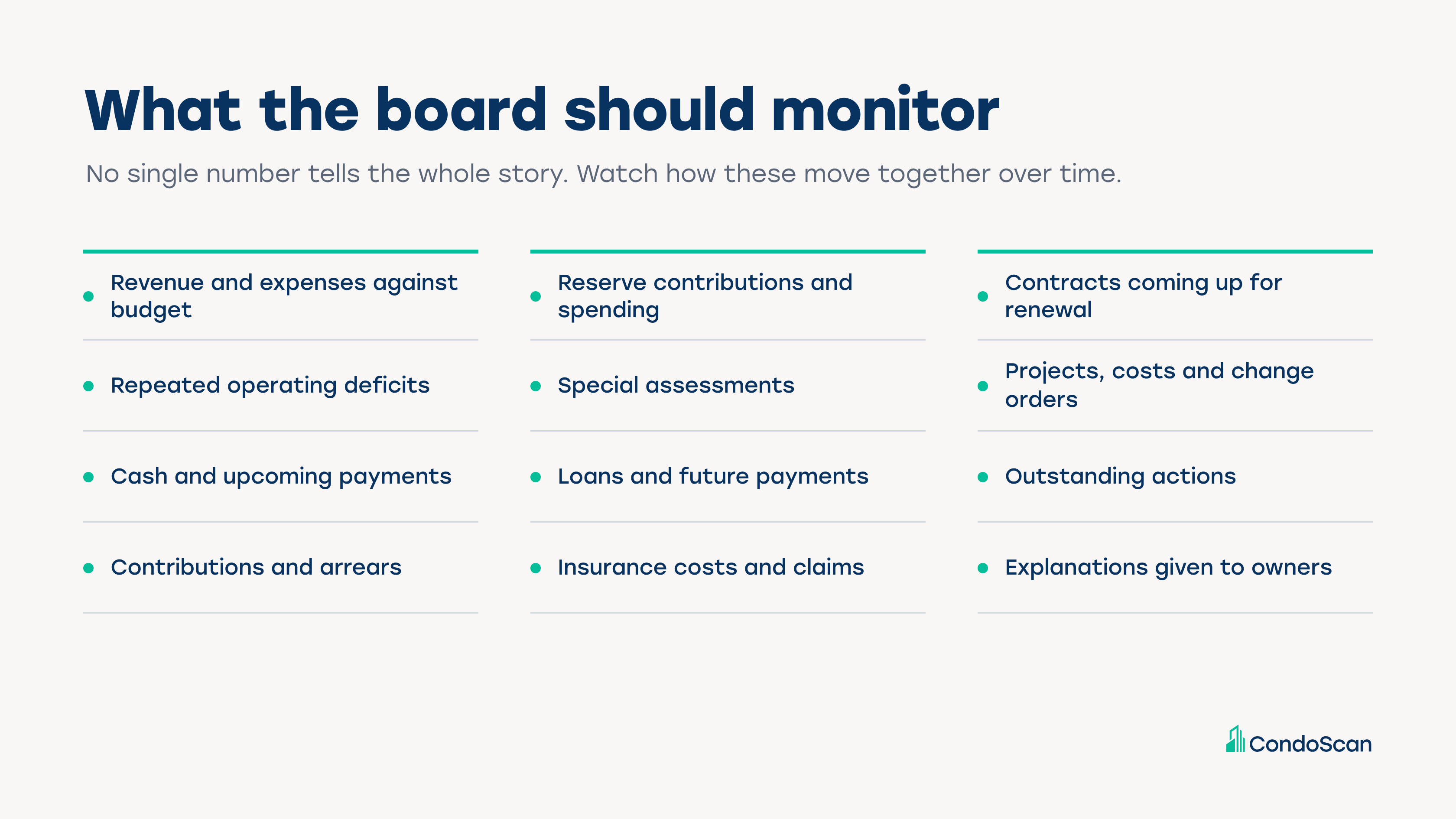
At each regular financial review, the board should consider:
- actual revenue and expenses compared with budget
- cash balances and upcoming payments
- contributions billed, received, and overdue
- arrears and the authorized collection process
- reserve contributions and expenditures compared with the plan
- current projects, approved costs, and change orders
- loans or financing and future payments
- insurance premiums, deductibles, and claim costs
- contracts approaching renewal
- repeated operating deficits
- proposed or approved special assessments
- information that should be explained to owners
The goal is not to eliminate every variance. Buildings are unpredictable. The goal is to recognize when the numbers have changed, understand why, and record what the board is doing about it.
From a buyer's perspective, unexplained patterns create the most concern. If expenses exceed budget for three years, a buyer will want to know why. If fees are being held steady while the reserve plan calls for higher contributions, a buyer will want to know how the planned work will be funded.
Clear reporting cannot make a financial issue disappear. It can show that the board understands the issue and has a plan.
How should a board use its reserve fund study and plan?
The reserve fund study is a long-range assessment of the corporation's depreciating property. It estimates what may need repair or replacement, when the work may be required, and what it may cost. The reserve fund plan is the board's approved response to that study.
Think of the study as the map and the plan as the chosen route. The study says what may be ahead. The plan explains how the corporation intends to prepare for it.
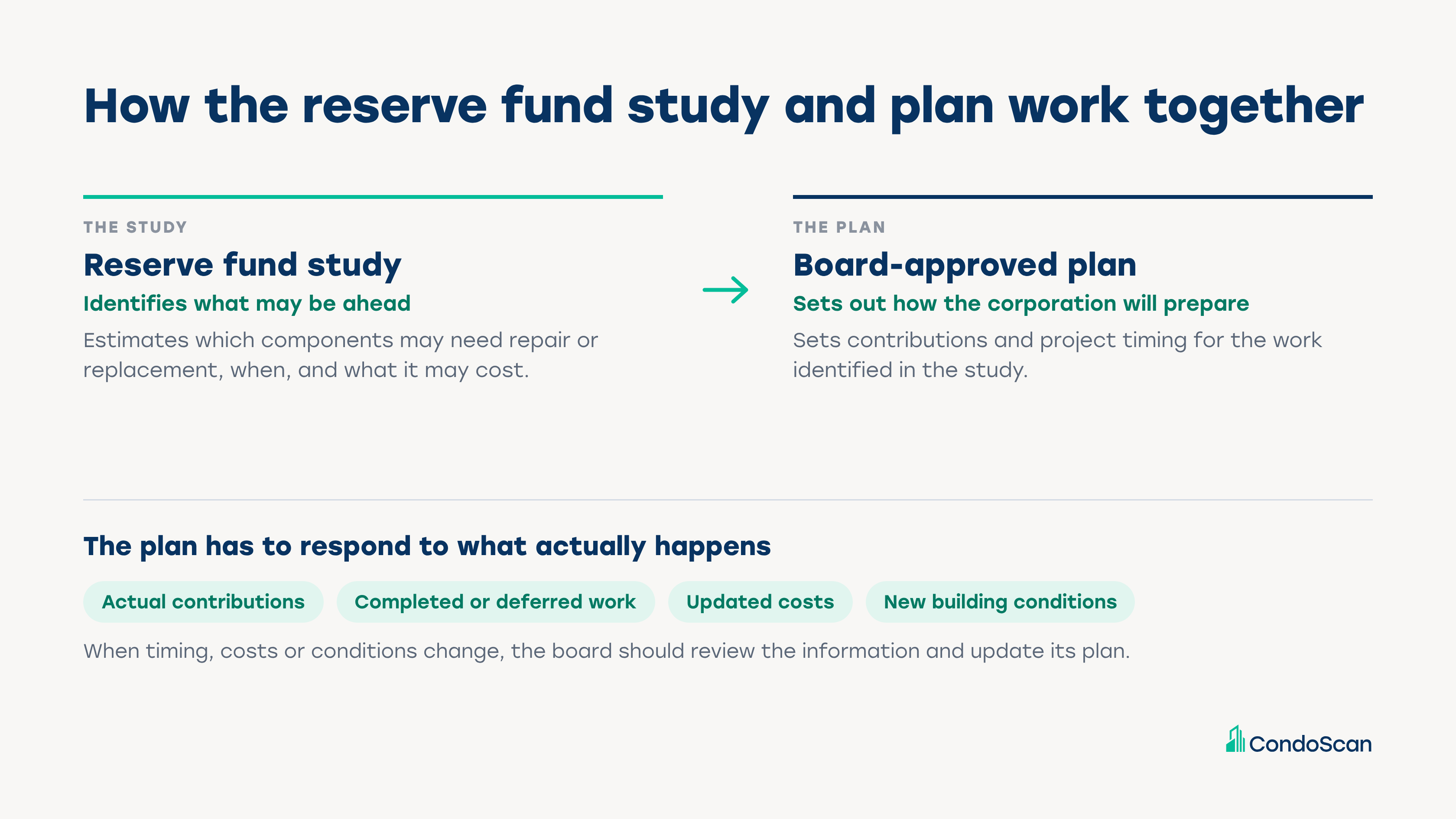
Alberta guidance says a reserve fund study must be completed at least every five years and should consider a 30-year timeframe. The initial study, report, and plan are generally required within two years after the condominium plan is registered. The current legislation and government guidance should be checked for the complete requirements and any exceptions.
The reserve fund balance is only one part of the analysis. The board should review:
- which components and projects appear in the study
- when the work is expected
- what the study estimates it will cost
- what assumptions the projections use
- what the corporation is actually contributing
- what work has been completed or deferred
- whether new conditions have changed the plan
If a project is deferred, the building does not become younger. The scope, timing, and cost may change, and those changes should be supported by appropriate advice and reflected in the board's records.
Buyers and reviewers notice when the documents stop lining up. If the study schedules a roof replacement, the minutes record a delay, and the budget shows no corresponding change, the natural question is: what is the new plan?
What makes condo board meeting minutes useful?
Useful minutes record decisions and material corporate business without becoming a transcript. They should help an owner, future director, or authorized reader understand what the board decided and what happens next.
"The board discussed the roof" is not very helpful. Did the board receive an engineering report? Approve repairs? Request bids? Defer the project? Ask the manager for more information?
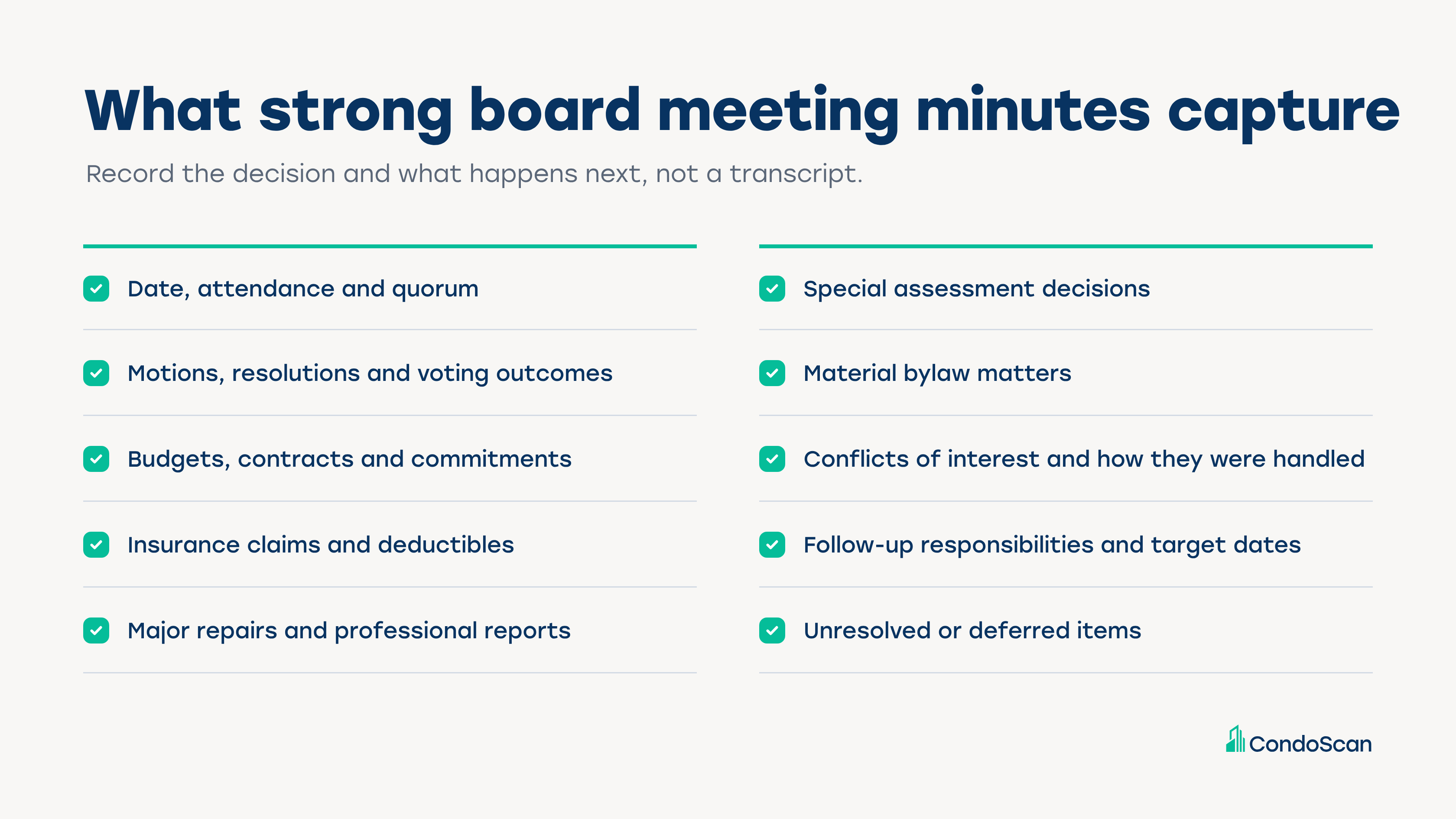
Strong minutes commonly capture:
- the meeting date, attendance, and quorum
- motions, resolutions, and voting outcomes
- approved budgets, contracts, and material commitments
- major repairs and professional reports
- insurance claims or significant deductible matters
- special assessment discussions and decisions
- material bylaw matters, with appropriate privacy controls
- unresolved issues or items deferred for more information
- follow-up responsibilities and target dates
- conflicts of interest and the process followed, where applicable
Minutes should distinguish between discussion and approval. They should preserve the decision without recording every opinion expressed in the room.
Privacy also matters. Government of Alberta guidance explains that some personal information may reasonably be recorded for meeting procedure or authorized condominium business, while enforcement complaints and unrelated personal details may not be appropriate for broader disclosure. The guidance also recommends destroying notes or recordings used to prepare minutes once the minutes are approved.
The answer is not to remove material information so the corporation looks better to buyers. The answer is to create accurate, proportionate minutes that document the corporation's business without unnecessarily exposing personal information.
How should a condo board handle document requests?
A corporation should use one consistent process to confirm who is requesting the information, locate the current records, protect private information, and record exactly what was supplied.
A buyer's condition deadline can be short. When the request arrives, that is not the time to discover that half the records are in a former director's email account.
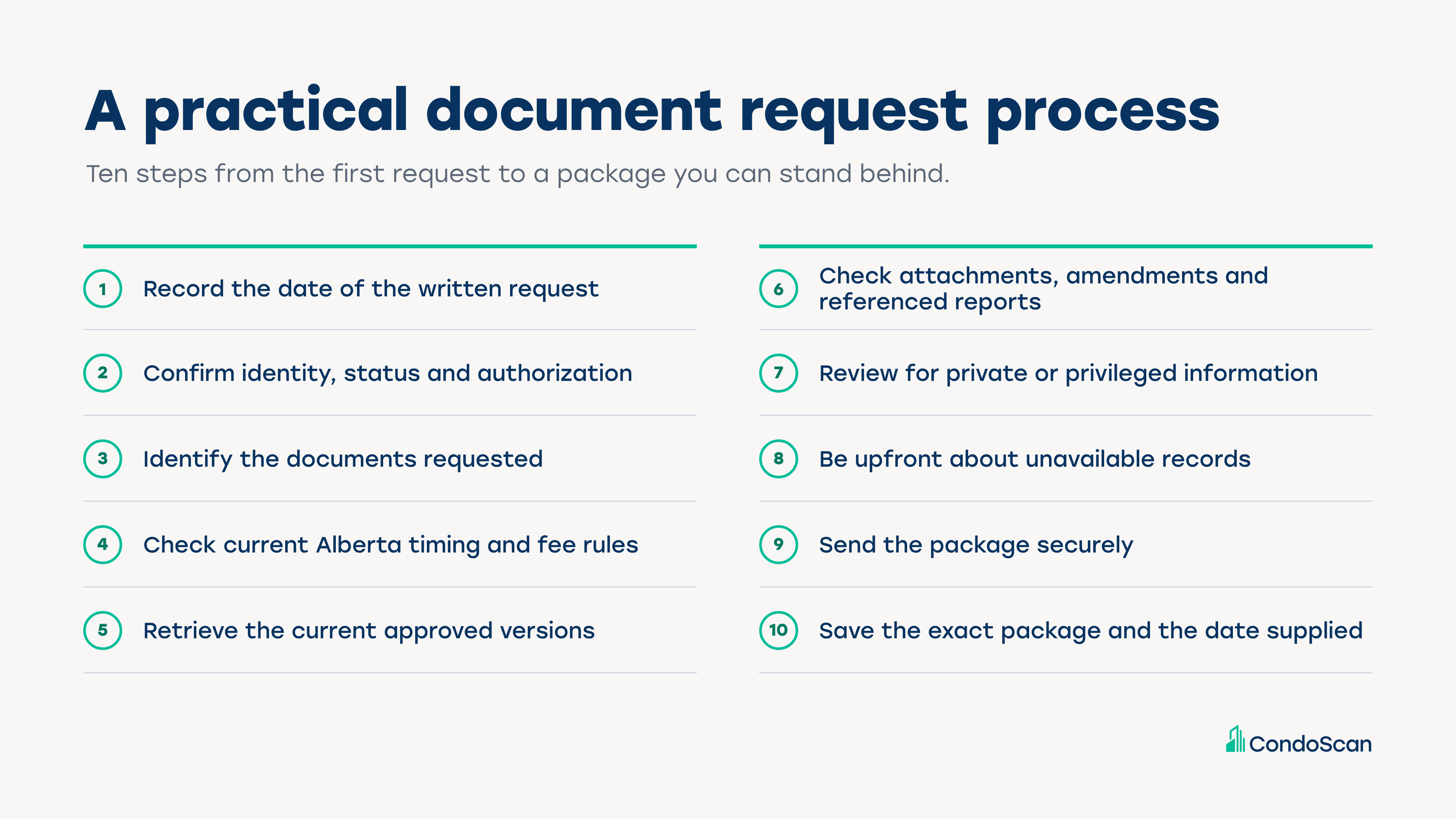
- Record the date the written request was received.
- Confirm the requester's identity, status, and authorization.
- Identify the exact documents requested.
- Check the current Alberta document list, timing, and fee rules.
- Retrieve the approved current versions from the master repository.
- Check for missing attachments, amendments, or referenced reports.
- Review the package for private or privileged information.
- Identify unavailable records honestly.
- Send the documents securely.
- Save a copy of the exact package and record when it was supplied.
Current Government of Alberta condominium-document guidance says specified documents must generally be supplied within 10 days after a written request. It also sets maximum fees and addresses rush requests fulfilled within three days. Boards and managers should use the current fact sheet and the Condominium Property Regulation when responding, because the exact list, fees, and rules can change.
Owners and prospective purchasers may have statutory rights to specified records. Realtors, lawyers, and document reviewers commonly receive records as the client's authorized representative. Confirm authority rather than assuming every person involved in a transaction has an independent right to every record.
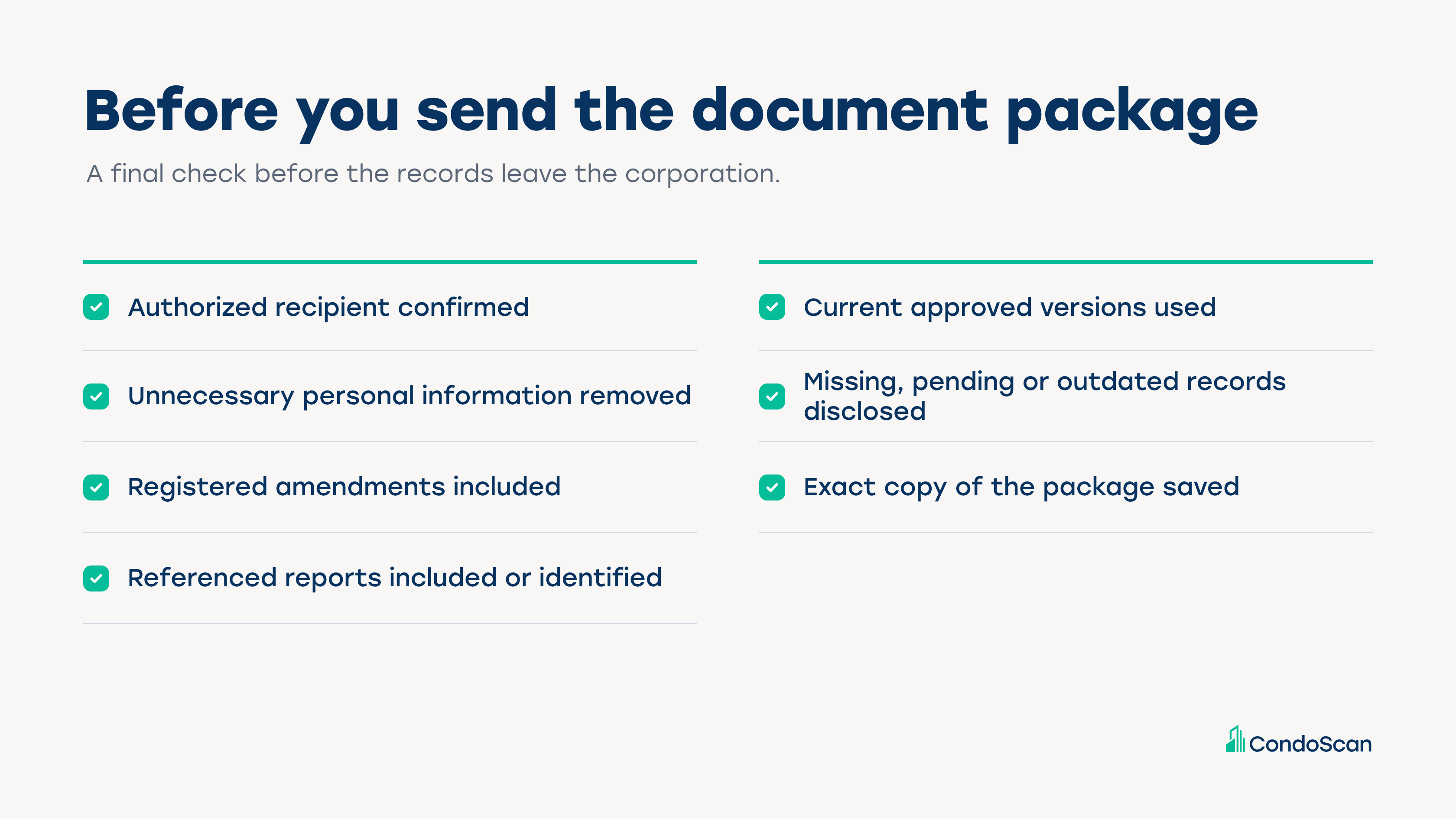
Before sending the package, confirm that you have:
- confirmed who is authorized to receive it
- used the current approved version of every document
- included registered amendments and related schedules where applicable
- made sure referenced reports are included or identified as unavailable
- checked for unnecessary personal information
- stated clearly when a record is missing, pending, or outdated
- kept an exact copy of what was sent
How do board records affect a buyer's condo document review?
A document reviewer does not read each record in isolation. The real value comes from comparing the documents and seeing whether they tell a consistent story. CondoScan's Alberta buyer's guide walks through that review from the buyer's side.
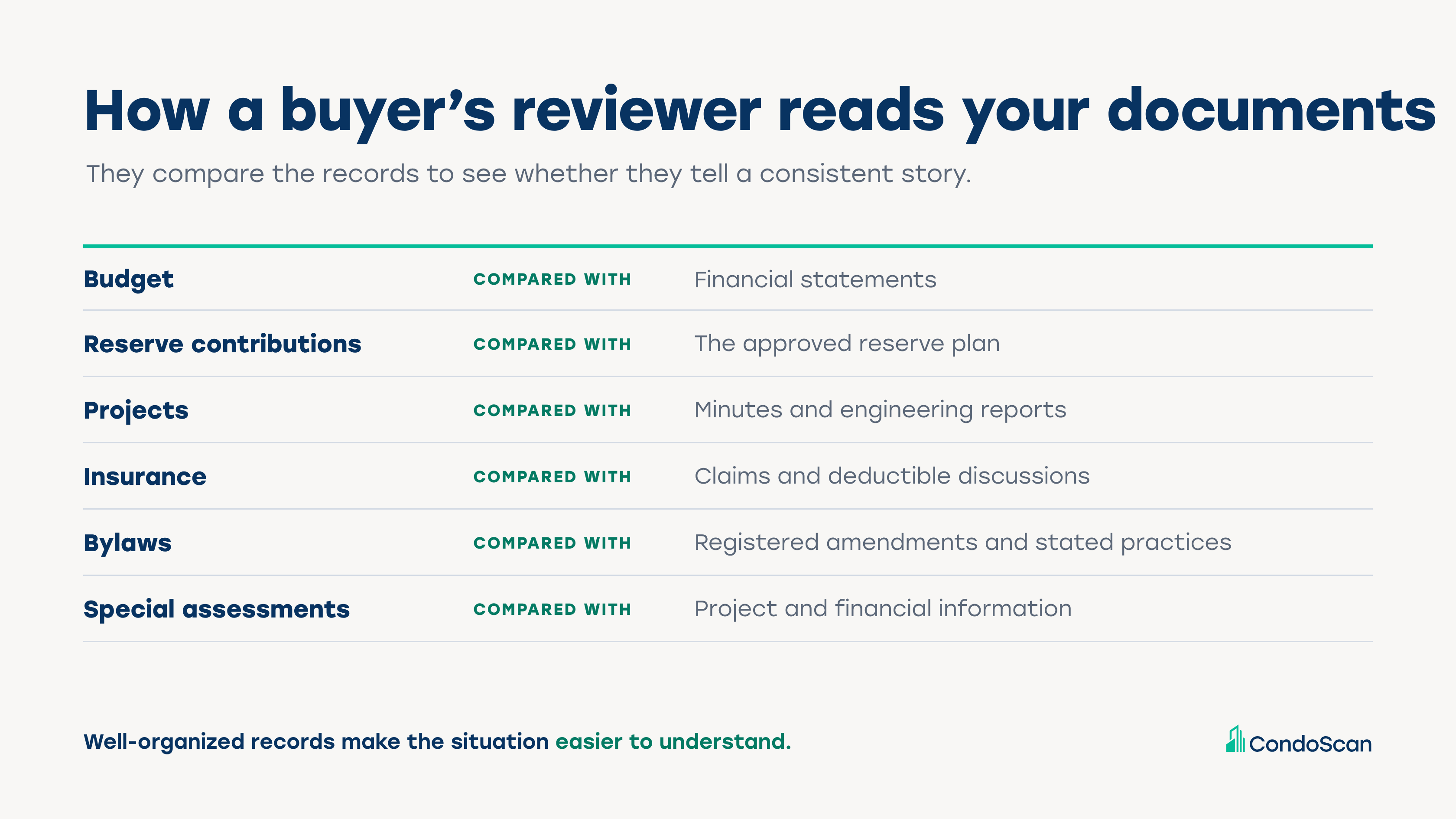
A reviewer may compare:
- the budget with the financial statements
- reserve fund contributions with the approved plan
- planned projects with meeting minutes and engineering reports
- insurance information with claim or deductible discussions
- bylaws with registered amendments and stated practices
- special assessment records with project and financial information
- estoppel information with other unit and corporation records
- statements in one document with evidence in another
Imagine the reserve fund study schedules a parkade project for this year. The minutes say the project was postponed. The financial statements show money was spent on an engineering report, but the budget includes no new project amount.
None of those facts automatically means the corporation is poorly managed. Together, they create reasonable questions: Why was the project delayed? Has the scope changed? What did the engineer recommend? How will the work now be funded?
That is why document readiness is not about making the corporation look perfect. It is about making the situation understandable.
A clear document package does not guarantee a positive review. A disorganized package does not automatically prove poor management. But complete, current, and consistent records give the buyer fewer unanswered questions and allow the corporation's actual decisions to speak for themselves.
Through more than 500 Alberta condominium reviews, CondoScan has encountered recurring buyer questions involving finances, reserve planning, projects, insurance, bylaws, and missing context. This experience is not a statistical study and should not be presented as evidence about all Alberta condominium corporations.
What documentation problems create confusion?
Most documentation problems are not dramatic. They are ordinary gaps that become difficult when a director leaves, a claim occurs, or a buyer needs answers quickly.
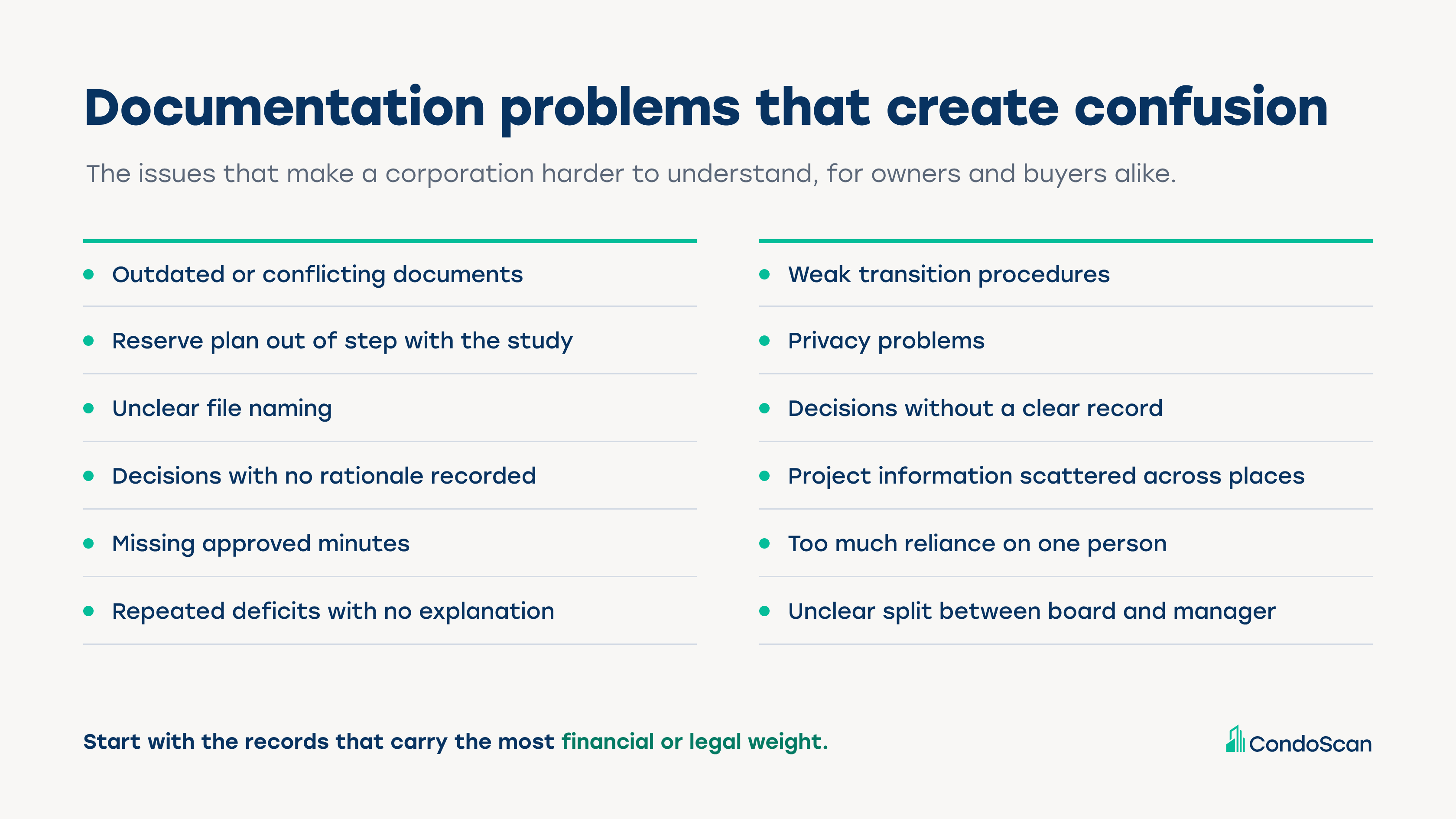
Common issues include:
- Outdated or conflicting documents. The package contains an old budget, superseded bylaws, or draft minutes.
- Missing approved minutes. Months of corporate history cannot be confirmed.
- Decisions without a clear record. Spending appears in the statements, but the approval or purpose is difficult to locate.
- Reserve-plan misalignment. Contributions, budgets, or project timing no longer reflect the plan, without an explanation.
- Repeated deficits without context. The pattern is visible, but the reason and response are not.
- Scattered project information. Engineering reports, bids, minutes, contracts, and invoices are stored separately with no project index.
- Weak file naming. No one can confidently identify the current version.
- Poor transition procedures. Records, passwords, or knowledge leave with a director or manager.
- Overreliance on one person. One volunteer knows the entire system and no one else can use it.
- Missing rationale. The minutes record what happened without enough context to understand why.
- Privacy problems. Packages include unnecessary owner details, contact information, or complaint history.
- Unclear board-manager responsibility. Each side assumes the other maintains the authoritative record.
Do not try to solve everything in one weekend. Start with the records carrying the greatest financial or legal significance. Identify the gaps, assign an owner, and set a date to close each one.
What should a condo board review throughout the year?
A board should use a recurring management rhythm instead of waiting for the annual general meeting or the next document request. The exact timing depends on the corporation's fiscal year, bylaws, contracts, and statutory requirements.
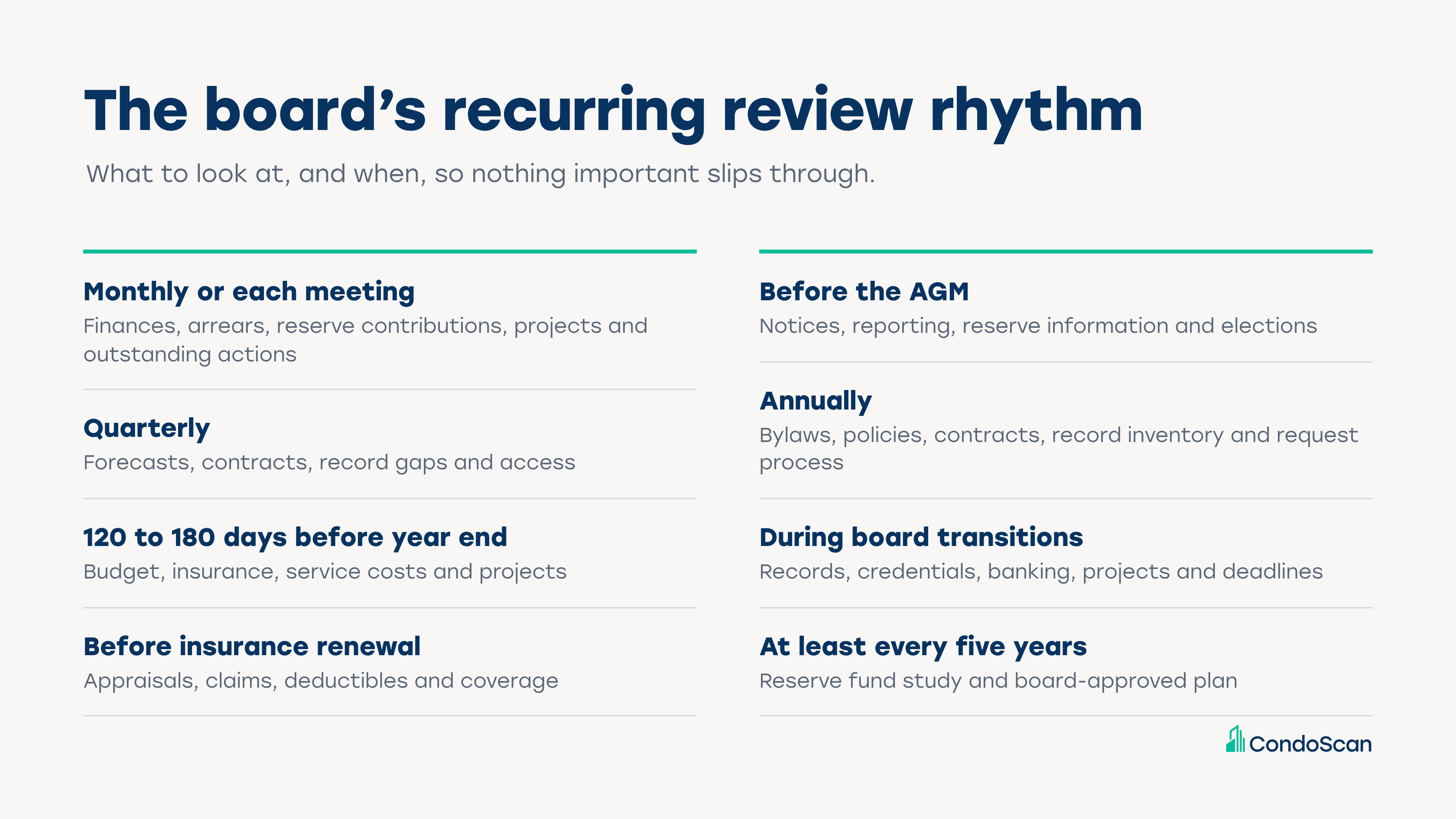
| Timing | Practical board review |
|---|---|
| Monthly or at each regular meeting | Financial results, cash, arrears, reserve contributions, projects, maintenance, contracts, claims, and outstanding actions |
| Quarterly | Project forecasts, contract performance, record gaps, access permissions, and recurring owner concerns |
| 120 to 180 days before fiscal year end | Budget assumptions, insurance outlook, service costs, reserve contributions, and known project expenses |
| Before insurance renewal | Appraisal needs, claims, deductibles, coverage changes, and owner communication with the broker |
| Before the annual general meeting | Notices, financial reporting, reserve information, elections, and the final owner package |
| Annually | Bylaws, policies, contracts, reserve-plan alignment, document inventory, and the request process |
| During any board or manager transition | Records, credentials, banking, contracts, projects, claims, disputes, and deadlines |
| At least every five years, subject to current law | Required reserve fund study and the related board-approved plan |
Annual document-readiness check
Before closing the annual review, confirm that:
- the registered bylaws and amendments are complete
- approved minutes are current and easy to locate
- financial statements and budgets cover the expected periods
- the reserve fund study, report, plan, and annual reporting are stored together
- insurance information is current
- active contracts and renewal dates are listed
- major project records are organized by project
- legal and privileged files have restricted access
- unit, parking, and storage records identify their source
- the document-request log is current
- the corporation controls the repository and administrative access
Where can Alberta condo directors get training?
New directors do not have to learn the job only from the last set of minutes. The Canadian Condominium Institute runs director education through two Alberta chapters. Schedules, fees, and registration change, so use the chapter site for the current session.
CCI South Alberta, based in Calgary, offers CM101 Directors Education. It is a 3.5-hour introduction to board governance, board meetings, and running an annual general meeting. The seminar covers the role of the board and management, the directors' code of ethics, the Condominium Property Act, bylaws, board confidentiality, officers, proxies, notice of meetings, nominations and elections, minutes, conflict of interest, and rules of conduct and order. As listed in October 2026, the course is free for members and $295 for non-members. Course descriptions are on the CCI South Alberta education page.
CCI North Alberta, based in Edmonton and serving condominiums from Red Deer north, offers Condo Board Basics & Best Practices. It is a self-paced online course for new and experienced board members, covering the foundations of board service. As listed in October 2026, it is free for members and $75 for non-members. Members request access by emailing info@ccinorthalberta.com. The chapter also runs a three-level Condominium Management series: CM100 on governance basics, CM200 on advanced governance, and CM300 on financial and physical stewardship. Sessions are hybrid, in person at NAIT in Edmonton and online. Upcoming dates are on the CCI North Alberta education page.
When should a condo board involve a professional?
A board should involve a qualified professional when the decision exceeds the board's knowledge, authority, independence, or available time, or when a technical opinion may materially affect safety, rights, or finances.
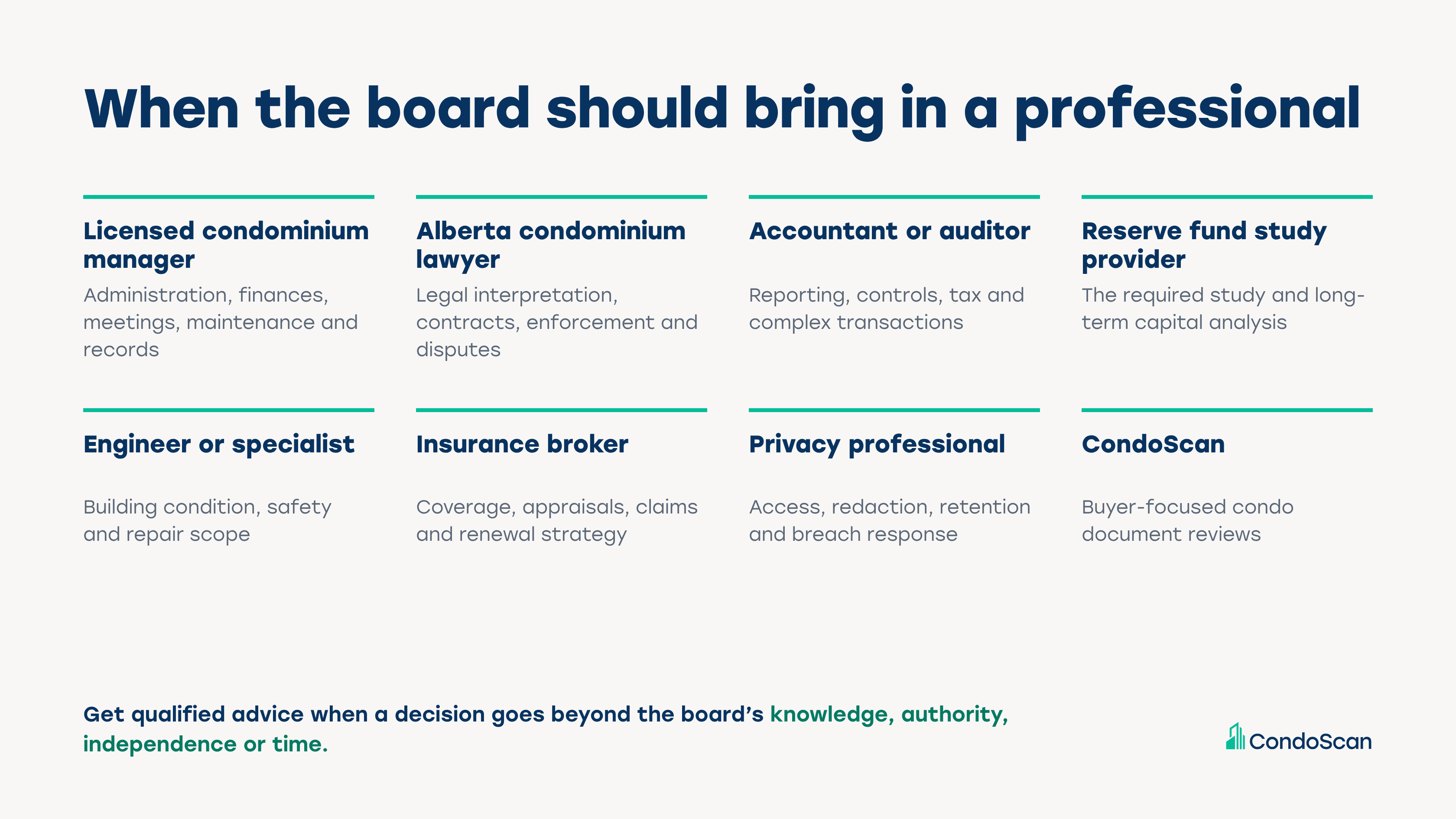
Depending on the issue, the board may need:
- a licensed condominium manager for recurring administration, finances, meetings, maintenance coordination, and records
- an Alberta condominium lawyer for legal interpretation, contracts, enforcement, collections, disputes, or disclosure questions
- an accountant or auditor for financial reporting, controls, tax, or complex transactions
- a qualified reserve fund study provider for the required study and long-term capital analysis
- an engineer or technical specialist for building condition, safety, repair scope, and project oversight
- a licensed insurance broker for coverage, appraisals, deductibles, claims, and renewal strategy
- a privacy professional or lawyer for personal-information policies, access, redaction, retention, or breach response
CondoScan's role is different. CondoScan reviews condominium documents for buyers and explains the available information from the buyer's perspective. It does not replace the corporation's professional advisers.
How can a board help owners and buyers navigate document review?
A board does not need to sell the building to a buyer. It does not need to make the corporation look perfect. The most useful thing it can do is provide a clear, current package and be honest about what is missing, pending, or still being decided.
Practical steps include:
- identify who receives document requests
- maintain one source for approved records
- provide current documents and applicable amendments
- identify missing or pending records accurately
- avoid assurances that are not supported by the records
- direct legal, technical, accounting, and insurance questions to the correct professional
- understand why a buyer may hire an independent document reviewer
When a buyer or Realtor asks for an Alberta document reviewer, a board or manager may choose to identify available resources, subject to its bylaws, policies, conflict rules, and legal advice. A board should not imply that it guarantees the provider's work or the outcome of a review.
CondoScan can be one Alberta resource a board or manager becomes familiar with before that question comes up. The goal is not to pressure a board into an endorsement. It is to make the introduction before someone is working against a purchase deadline.
Want to understand what buyers see when they receive your corporation's documents? CondoScan has reviewed documents for more than 500 Alberta condominiums. If your board or management team would like to understand the questions buyers and document reviewers commonly ask, or become familiar with CondoScan when an owner or Realtor needs a reviewer, book a short introduction with Nyle.
Clear records make the full picture easier to understand
A well-managed corporation is not one that never faces a difficult repair, insurance claim, or budget decision. Every property will have issues over time.
What matters is whether the board understands the situation, makes informed decisions, and keeps records that explain what happened. That helps current owners, supports future directors, and gives buyers a more accurate picture of the corporation they may join.
CondoScan has reviewed documents for more than 500 Alberta condominiums. If your board or management team would like to understand what buyers and document reviewers look for, or become familiar with CondoScan as a resource when an owner or Realtor asks for a reviewer, book a short introduction with Nyle.
This guide is educational and is not legal, accounting, engineering, insurance, privacy, or property-management advice. The legislation, bylaws, facts, and professional responsibilities that apply to a particular corporation may differ. Obtain advice from an appropriately qualified Alberta professional.
Sources
- Condominium Property Act, Government of Alberta and Alberta King's Printer
- Condominium Property Regulation, Alta Reg 168/2000, current consolidation
- Condominium Information, Government of Alberta
- Owning a Condominium, Government of Alberta
- Condominium Documents for Owners, Mortgagees and Prospective Purchasers, Government of Alberta, 2026
- Reserve Funds, Government of Alberta
- Reserve Fund Study Providers, Plans and Reports, Government of Alberta, updated March 31, 2026
- Personal Information and Condominium Corporations, Government of Alberta
- Real Estate Act, Real Estate Council of Alberta
- Licence Types, Real Estate Council of Alberta
Frequently asked questions
What is a condo board responsible for in Alberta?
An Alberta condo board governs the condominium corporation and carries out its responsibilities under the Condominium Property Act, Regulation, and registered bylaws. Its work commonly includes finances, reserve planning, maintenance oversight, insurance, meetings, records, contracts, and owner communication. A manager may perform day-to-day work, but the board remains responsible for governance and oversight.
Can an Alberta condominium corporation manage itself?
Yes. The Real Estate Act excludes a condominium corporation managing its own affairs from the condominium-management licensing requirement. A self-managed corporation must still meet the legal, financial, privacy, and governance obligations that apply to it. The board may hire specialists without retaining a full-service management company.
Does an Alberta condo board need a professional manager?
Not necessarily. The right choice depends on the property's size and complexity, volunteer capacity, continuity needs, risk, and budget. If the corporation hires someone to provide condominium management services, the board should verify the applicable RECA licensing and define the scope in a written agreement.
What is the difference between a condo board and a condominium manager?
The board is elected by owners to govern the corporation and make authorized decisions. A condominium manager or management company performs contracted services as the corporation's agent. The manager may administer finances, meetings, maintenance, communication, and records, but the management agreement does not replace the board's governance responsibilities.
What documents should a condo board maintain?
A board should maintain the records required by Alberta law and the documents needed to govern the corporation. These commonly include the plan, bylaws, minutes, budgets, financial statements, reserve fund records, insurance information, contracts, maintenance reports, assessment records, unit-related records, and request logs. The current government fact sheet provides the authoritative document-request list.
How often should a condo board review its finances?
The board should review financial information often enough to identify cash-flow, arrears, spending, and project issues before they become urgent. Monthly review, or review at each regular board meeting, is practical for many corporations. Annual statements alone are not a substitute for recurring oversight.
How often does an Alberta condominium need a reserve fund study?
At least every five years under current Alberta requirements. Government guidance says the study should consider a 30-year timeframe. A corporation may obtain a study sooner if its property or planning needs justify it. The board must also prepare a reserve fund plan and provide required annual reporting.
What should condo board meeting minutes include?
Minutes should record the meeting, quorum, motions, decisions, material commitments, and follow-up without becoming a transcript. They should clearly distinguish discussion from approval and provide enough context for owners and future boards. Personal information should be limited to what is authorized and reasonably required for condominium business.
Who can request condominium documents in Alberta?
The Act and Regulation provide document-access rights to specified parties, including owners, mortgagees, and prospective purchasers, subject to the applicable rules. Realtors, lawyers, and document reviewers commonly receive records as an authorized representative. The corporation should verify status and authority before releasing information.
How quickly must an Alberta condominium provide requested documents?
Current Alberta guidance says specified documents must generally be provided within 10 days after a written request. Separate maximum fees apply, and the framework addresses rush production within three days. Boards and managers should consult the current fact sheet and Regulation for the exact rule that applies.
What information should a condo board protect for privacy?
The corporation should limit its collection, use, and disclosure of personal information to authorized and reasonable purposes. Some information may be required for meeting procedure or corporation business, while complaint, enforcement, and unrelated personal details may need restricted handling. A management company acting for the corporation is also subject to PIPA for the responsibilities it performs.
What happens if condominium records are missing?
The corporation should identify the missing record, search earlier board and manager archives, contact the responsible professional, and document the result. It should not assume that an unavailable record means no issue exists. Missing information may affect governance, owner access, and a buyer's ability to understand the corporation. Legal advice may be needed when a required record cannot be located.
Can a condo board recommend a document-review company?
A board may be able to identify available resources when an owner or Realtor asks, but it should follow its bylaws, policies, conflict rules, and legal advice. It should not imply certification, guarantee an outcome, or accept undisclosed benefits.
Why would a buyer hire a condo document reviewer?
A buyer may hire a reviewer to compare the corporation's finances, reserve planning, minutes, insurance, bylaws, and unit information before deciding how to proceed with a purchase condition. The reviewer can identify inconsistencies, missing context, and questions for other professionals. A review does not guarantee future costs or replace legal, inspection, accounting, or insurance advice.
Does CondoScan work for the condominium corporation or the buyer?
CondoScan's core service is professional condominium document review for buyers. It explains the available records from the buyer's perspective and does not manage, audit, or certify the condominium corporation. A board or manager may become familiar with CondoScan as a potential resource when a buyer or Realtor asks for a reviewer.