condo document review
Condo Document Review in Alberta: A Buyer's Guide
 CondoScan
If you are buying a condo in Alberta, you have probably hit this moment: the unit looks great, your condition deadline is days away, and a thick stack of condo documents just landed in your inbox.
That stress is fair. Most of what decides whether a condo is a good buy is not in the unit. It is in the corporation behind it: the finances, the reserve fund, the insurance, the bylaws, and years of meeting minutes.
But here's the good news: those same documents are the best advance warning you will ever get. Financial pressure, upcoming repairs, rules that do not fit your life, and special-assessment talk usually show up on paper long before they show up on your bill. You just need a way to read them before your conditions come off.
That is what a condo document review does. This guide breaks it into four steps you can actually follow during an Alberta condition period.
The four-step condo document review
- Collect. Get the full document package as soon as your offer is accepted.
- Compare. Read the finances, reserve fund, minutes, bylaws and insurance against each other, not one at a time.
- Question. Turn anything unclear, missing or inconsistent into specific questions for the seller, manager, reviewer or lawyer.
- Decide. Use the answers to decide whether to remove your condition, negotiate or walk away, before the deadline.
The sections below walk through each step.
What is a condo document review?
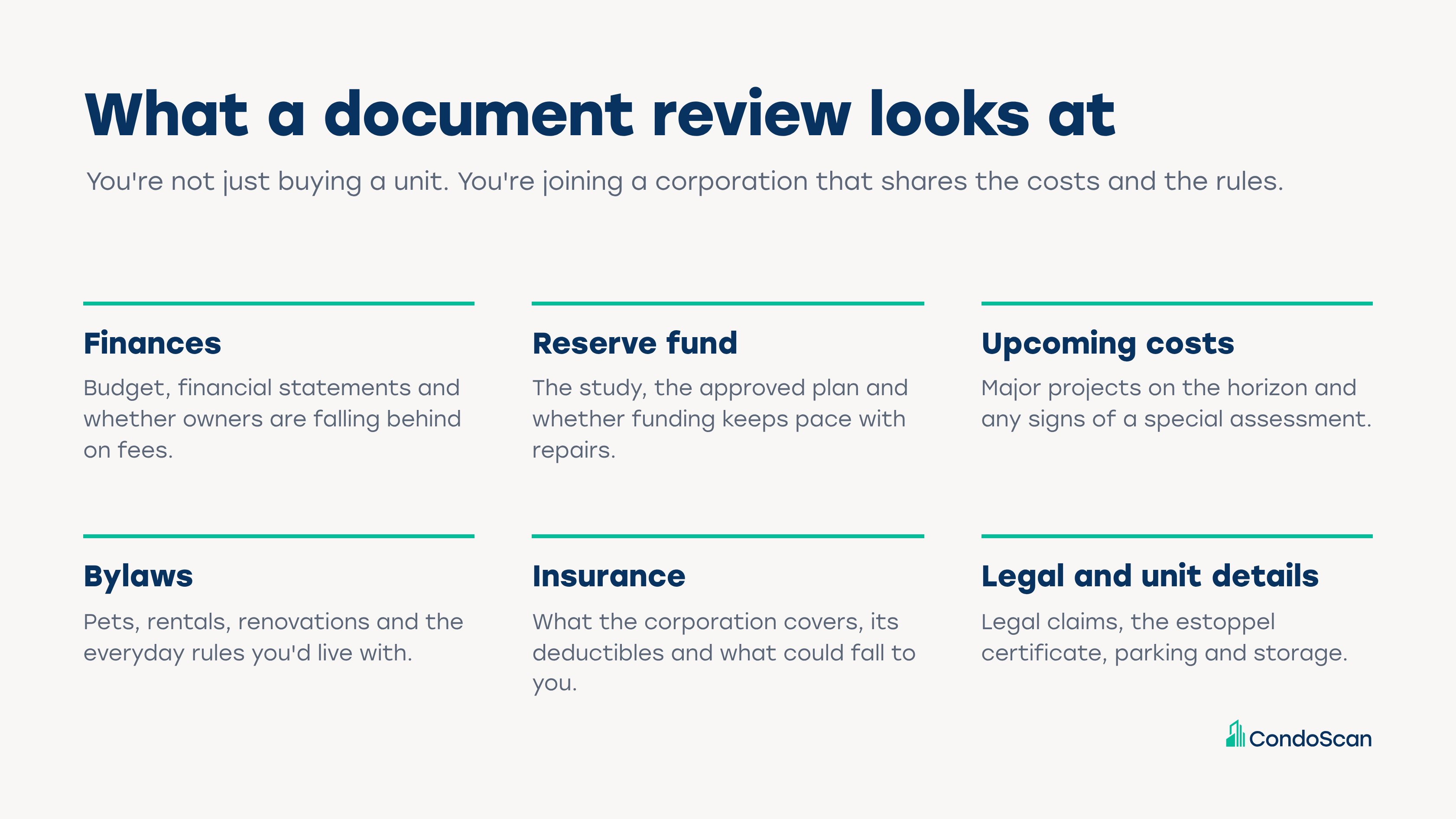
A condo document review is an assessment of the records connected to a condominium corporation and the unit you are considering buying.
Think of it this way: when you buy a condo, you are not only buying the space inside the unit. You are joining a corporation that manages shared property, collects condo fees, maintains common areas, buys insurance, and makes decisions that affect your costs and how you can use your home.
A good review helps you understand:
- The condominium corporation's financial position
- Whether the reserve fund appears prepared for future repairs
- Whether major projects or special assessments may be expected
- What the bylaws permit or restrict
- Whether the corporation is involved in legal disputes
- What the corporation's insurance covers
- Whether the available records appear complete and consistent
- Which findings require further clarification before you proceed
What it will not do is predict every future expense or tell you whether to buy. It organizes the information, flags what deserves a closer look, and gives you better questions to ask.
Basically: the review turns a stack of documents into a short list of things that matter to you.
Why should Alberta condo buyers review the documents?
Because a building can look great and still have problems you cannot see on a showing.
A new lobby, clean hallways, or a freshly painted exterior cannot tell you whether:
- The reserve fund is keeping pace with planned repairs
- Condo fees are sufficient to cover operating expenses
- Owners are falling behind on their contributions
- A major repair has been discussed but not yet approved
- Insurance premiums or deductibles have increased
- The corporation is involved in litigation
- Pets, rentals or renovations are restricted
- A parking stall is titled, assigned or part of an exclusive-use agreement
A home inspection looks at the physical property. A document review looks at the corporation and its records. They answer different questions, and you usually want both answered.
For a previously owned Alberta condominium, the Government of Alberta's purchasing guidance puts the responsibility for getting the documents and information on the buyer. It also notes that an offer can be made conditional on receiving the documents and the purchaser being satisfied with their contents. In other words, the condition period is your window, and the documents are your job.
What documents should an Alberta condo buyer review?
This is the Collect step. You cannot review what you do not have, so start by getting the full package.
The exact package varies by property and transaction. According to the Government of Alberta's guidance on purchasing a condominium and requesting condominium documents, a buyer may need to examine records such as the bylaws, budget, financial statements, meeting minutes, reserve fund information, insurance records, legal claims and estoppel certificate.
A thorough review will commonly consider the following records when they are available:
| Document | What it may help you understand |
|---|---|
| Condominium plan and unit title | The legal unit, unit factors and registered interests |
| Bylaws | Rules affecting pets, rentals, renovations, parking and everyday use |
| Current budget | Expected revenue, expenses and condo-fee requirements |
| Financial statements | The corporation's financial position and recent operating results |
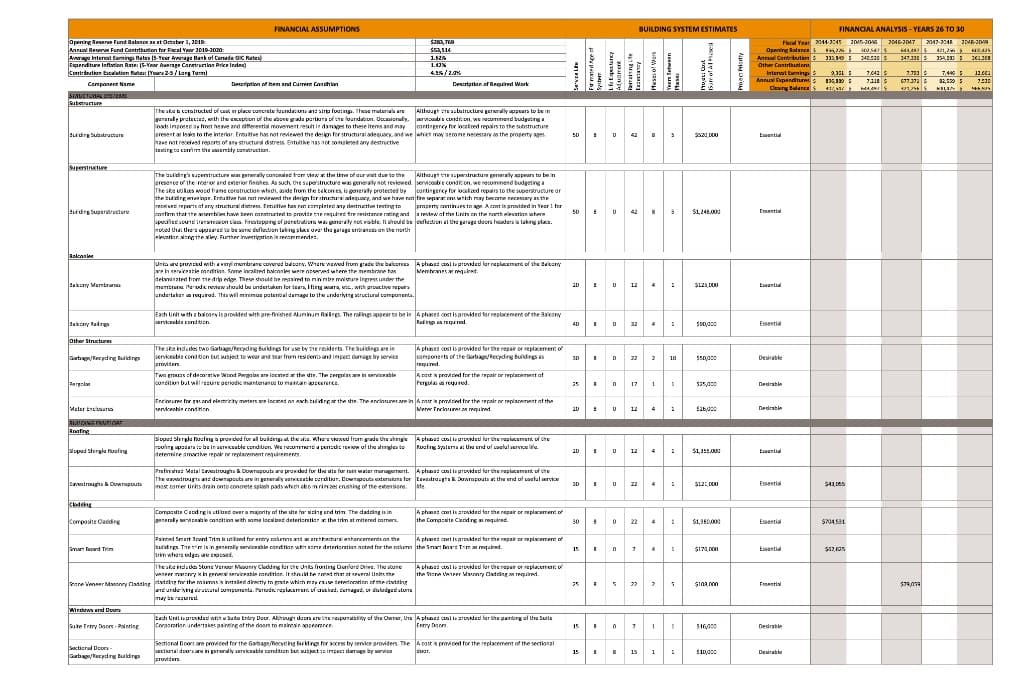
| Reserve fund study | The expected timing and estimated cost of major repairs and replacements |
| Reserve fund plan | How the board intends to fund the work identified in the study |
| Reserve fund reports | Contributions, expenditures and the reserve fund's current position |
| Board and general-meeting minutes | Repairs, disputes, projects, owner concerns and decisions under discussion |
| Insurance certificate or policy information | Coverage, deductibles and potential unit-owner exposure |
| Estoppel certificate | Contributions assessed to the unit and amounts that remain unpaid |
| Management and service agreements | Important contractual obligations and management arrangements |
| Special-assessment information | Approved or discussed additional charges outside regular condo fees |
| Legal claims or written demands | Known disputes and potential financial exposure |
| Parking and storage agreements | Whether these areas are titled, leased, assigned or exclusive-use property |
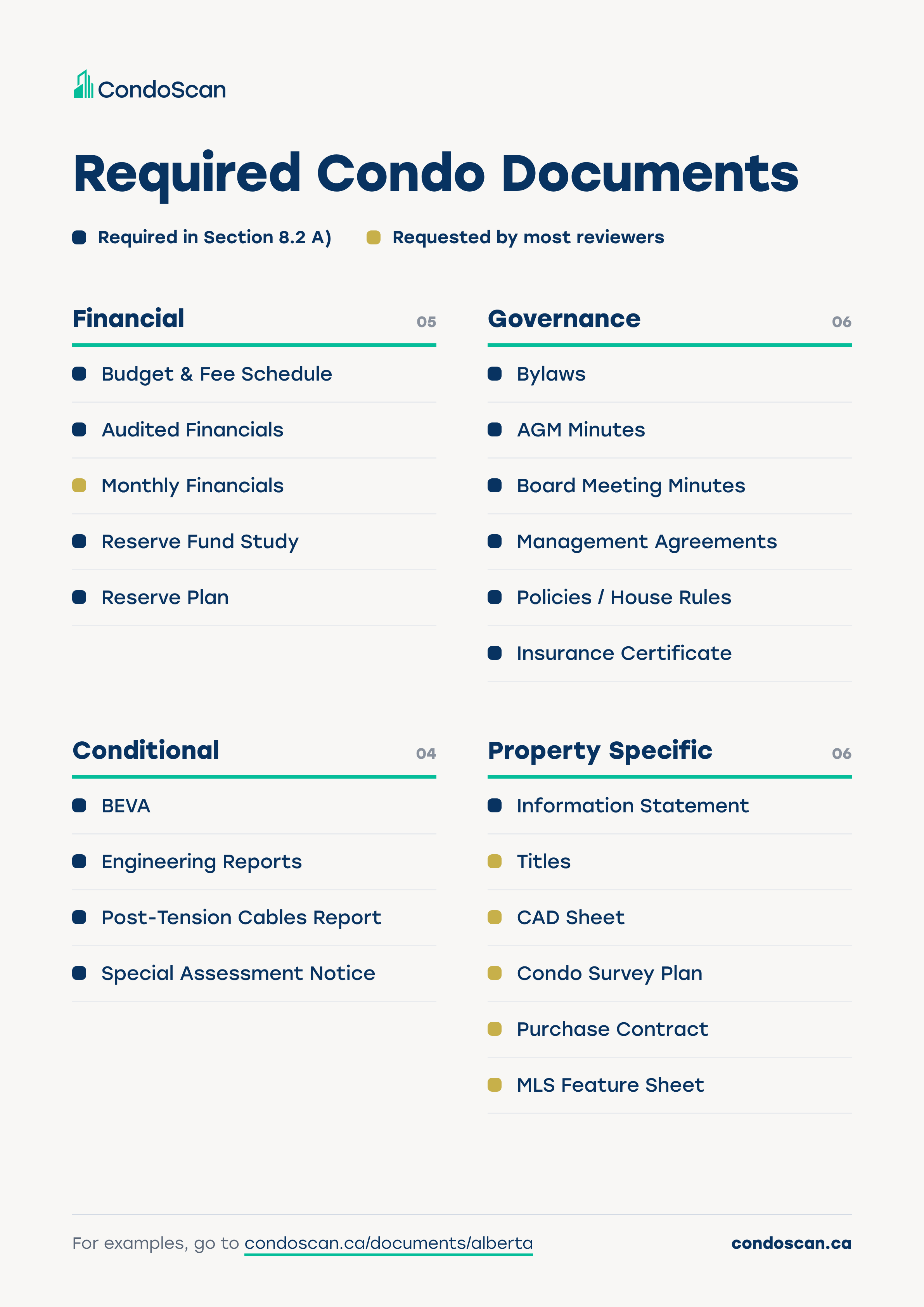
The Government of Alberta's condominium-document fact sheet has a more detailed list of what owners, mortgagees and prospective purchasers may request. Still confirm what is available for your transaction with your realtor, lawyer and document reviewer.
What financial risks can a condo document review reveal?
This is the Compare step, and it is where most DIY reviews go wrong: they read each document on its own.
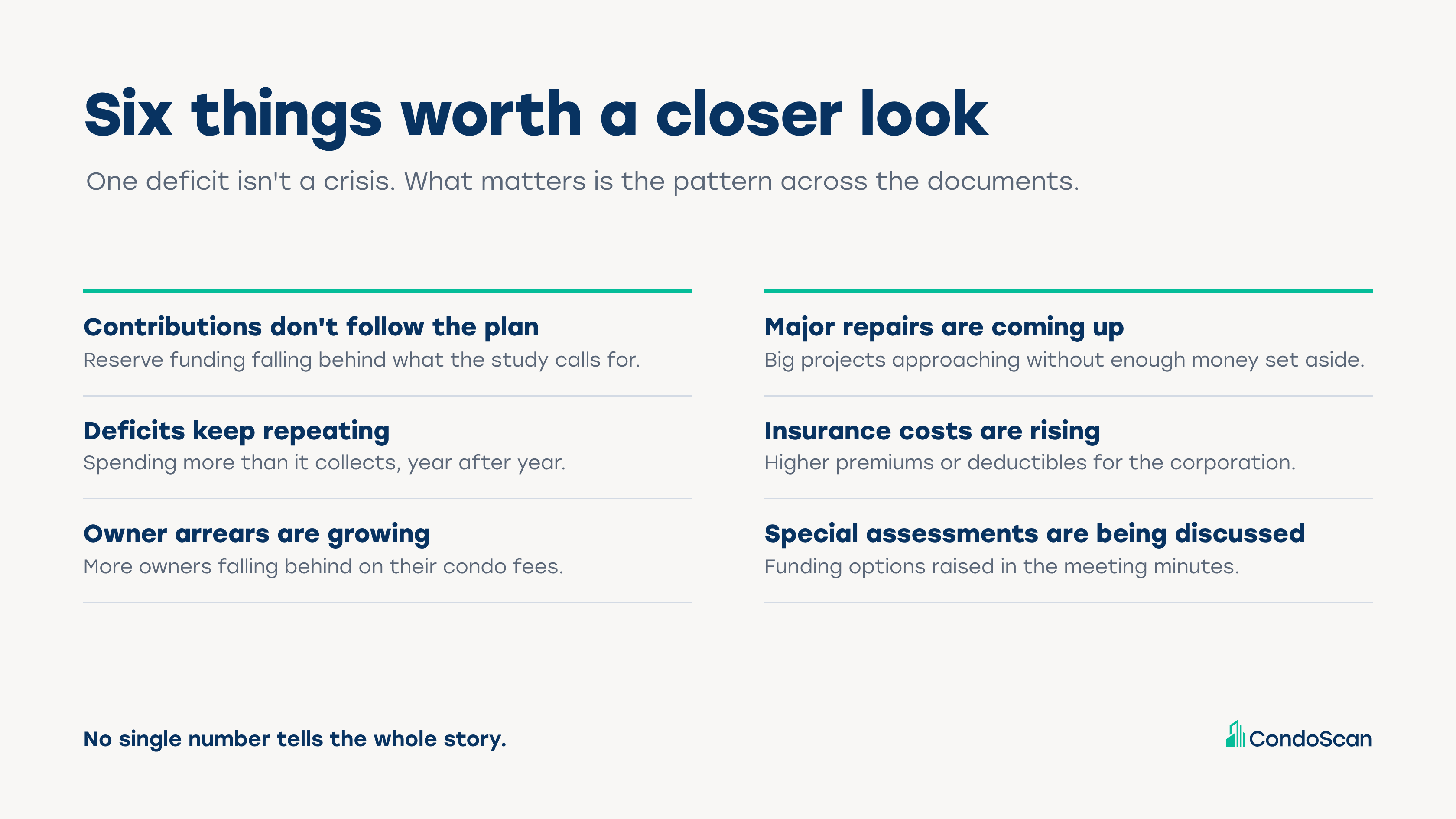
The real signal comes from comparing them. A review is not trying to label a corporation "good" or "bad." It is checking whether the finances, the plans and the obligations actually line up.
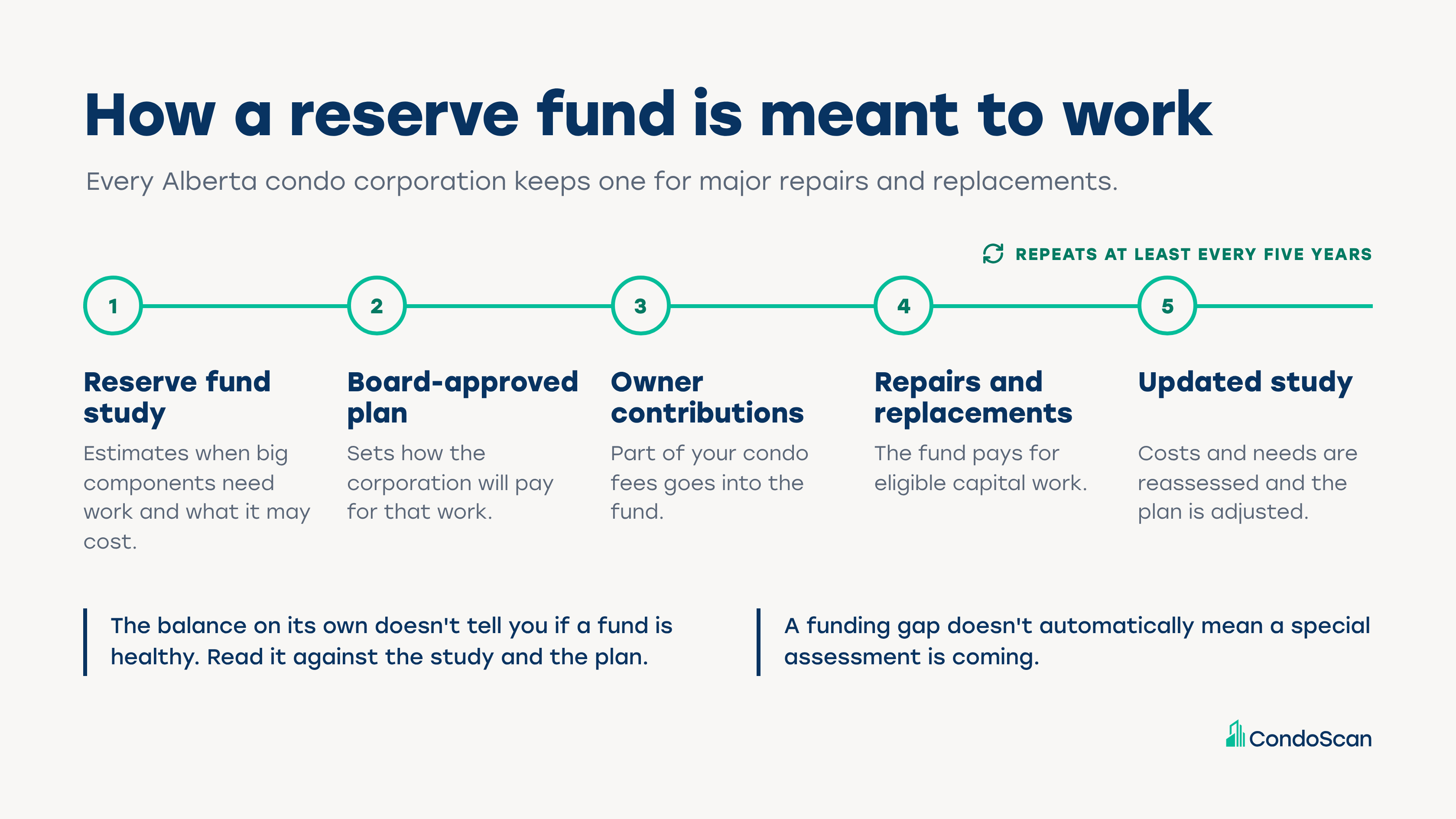
An underfunded or strained reserve fund
Under Alberta's Condominium Property Act and Condominium Property Regulation, condominium corporations must establish and maintain a capital replacement reserve fund for major repairs and replacement of depreciating property.
A reserve fund study is the map: it estimates when major components may need work and how much that work may cost. The reserve fund plan is the route the board chooses to pay for it.
That is why the account balance alone does not tell you much. A big number can still be short if a roof is due next year. Look at the balance alongside the study, the approved plan, recent spending and the timing of upcoming work.
Things worth a closer look:
- Contributions that do not appear to follow the approved plan
- Large projects approaching without enough money allocated
- Repeated deferral of recommended work
- Major differences between projected and actual costs
- An outdated study or missing reserve fund records
- Recent withdrawals that materially reduce available funds
Alberta's reserve fund requirements generally call for a new reserve fund study at least every five years. Even with a current study, ask whether the plan still responds to it and whether anything has changed since it was written.
Recurring operating deficits
A corporation that keeps spending more than it collects will eventually need to raise fees, cut services, defer work or ask owners for more money.
One deficit is not a crisis. A one-time variance from an unusual repair is very different from expenses beating revenue year after year. The pattern is what matters, and you only see it by comparing the budget with the financial statements, reserve fund activity and meeting minutes.
Condo-fee arrears
If several owners are behind on their fees, the corporation can feel the cash-flow squeeze. Arrears can also point to collection or governance problems.
Do not stop at the total. Is it one unit, a handful of owners, or a number that keeps climbing?
The Government of Alberta explains that an estoppel certificate identifies the contributions assessed against a unit, the payment schedule and whether amounts remain unpaid.
Special assessments
A special assessment, also called a special levy, is an extra charge to owners outside their regular condo fees. Corporations use them for large repairs, insurance costs, unexpected shortfalls or other obligations their existing funds cannot cover.
Here's the part buyers find surprising: the warning signs often show up well before anyone votes. Meeting minutes, budgets, engineering reports and reserve fund documents may mention:
- Major repairs being investigated or discussed
- Contractor or engineering estimates
- Reserve fund shortfalls
- Insurance losses or rising deductibles
- Financing discussions
- Board concern about how a project will be funded
No reviewer can promise a special assessment will or will not happen. The goal is to find the evidence that changes how you see the risk.
For a deeper dive, read CondoScan's guide to special assessments in Alberta condominiums.
What can the bylaws tell you about living in the condo?
The finances can look perfect and the building can still be wrong for you. That is the bylaws' job to tell you.
Depending on the corporation, the bylaws may address:
- Pets, including size, number or approval requirements
- Long-term rentals and short-term accommodation
- Renovations and board-approval requirements
- Smoking or cannabis use
- Noise and nuisance rules
- Age or occupancy restrictions where legally permitted
- Parking and storage
- Use of balconies and common areas
- Home-based businesses
- Owner responsibilities for repairs or insurance deductibles
Do not rely on the listing, the seller, or "that's how everyone does it here." The written bylaws and registered amendments are what apply after possession.
If a restriction really matters to your plans, ask your lawyer how the bylaw applies to you. The Alberta Condominium Property Act and its Regulation set the provincial framework, but every corporation has its own bylaws.
What do meeting minutes reveal?
If the financial statements are the numbers, the minutes are the story behind them.
Minutes may record:
- Water leaks or recurring building problems
- Elevator, roof, building-envelope, heating or parkade concerns
- Engineering investigations
- Insurance claims
- Legal disputes
- Planned capital projects
- Owner complaints
- Special-assessment discussions
- Proposed bylaw changes
- Problems involving the property manager, contractors or board
One complaint does not make a problem. Reviewers look for patterns, issues that never get resolved, and topics that connect the minutes to the budget and reserve fund documents.
The Government of Alberta includes recent board and general-meeting minutes among the records buyers should obtain and examine when purchasing a previously owned condominium.
What should buyers check in the corporation's insurance?
The corporation's insurance and your own condo-unit policy protect different things. Know what the building covers before you buy your own policy.
Alberta's condominium legislation includes rules on corporation insurance and on when a corporation may recover an insurance deductible from an owner. Current provincial information and interpretation bulletins are on the Government of Alberta's condominium information page.
Records worth checking:
- The corporation's current insurance certificate
- Policy deductibles
- The standard insurable unit description
- Information about improvements and betterments
- Recent claims or significant loss history
- Any deductible chargebacks connected to the unit
CondoScan's Alberta condo insurance guide explains the difference between corporation coverage and the personal coverage a unit owner may need. Then take the corporation's insurance information to a licensed insurance broker for advice on your unit.
How is a condo document review different from a home inspection?
Short answer: one checks the building, the other checks the business that runs it.
| Condo document review | Home inspection |
|---|---|
| Reviews corporation records and unit-related documents | Examines accessible physical components |
| Assesses financial and reserve fund information | Identifies visible defects and maintenance concerns |
| Reviews bylaws and governance records | Evaluates systems and components within the inspection scope |
| Looks for special-assessment indicators | Looks for physical evidence of damage or deterioration |
| Reviews insurance and legal information | Does not usually analyze corporation finances or bylaws |
| Helps explain shared obligations | Helps explain physical property condition |
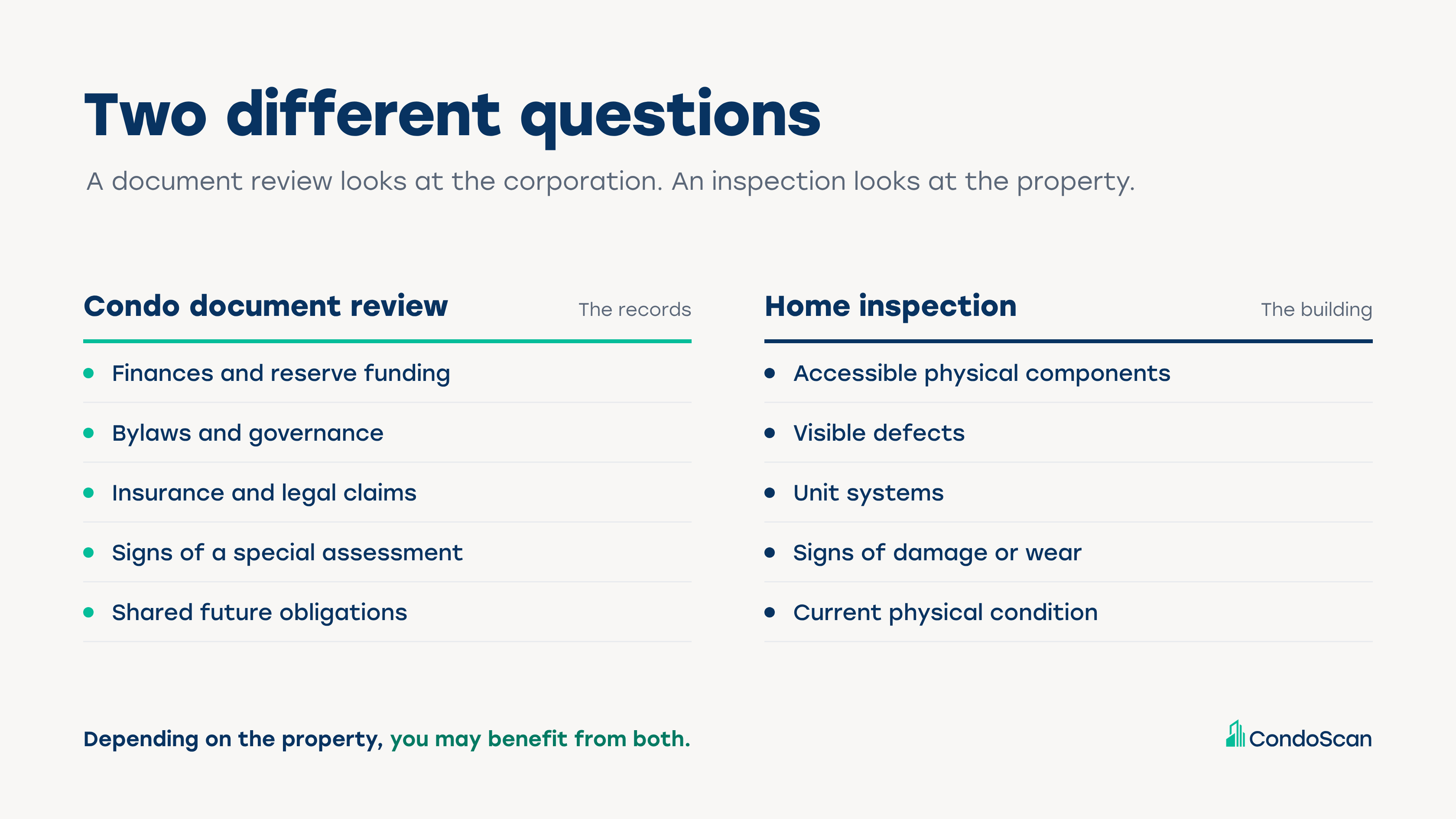
An inspection might find moisture, electrical, plumbing or mechanical concerns. A document review might find that the corporation is planning a roof replacement, facing an insurance increase or considering a special assessment.
Depending on the property and your conditions, you may want both.
How long does a condo document review take?
Timing depends on two things: whether the full set of documents is in, and the reviewer's service standard.
CondoScan's standard residential review is delivered within 24 hours after the complete documents have been received.
The biggest delay is almost never the review itself. It is waiting on missing records. So start collecting the moment your offer is accepted, not at the end of the condition period.
A practical sequence looks like this:
- Confirm the condo-document condition and deadline in the purchase contract.
- Request the available records immediately.
- Check whether expected documents are missing or outdated.
- Submit the package for review.
- Read the findings and note unresolved questions.
- Discuss material concerns with the appropriate professionals.
- Decide how to proceed before waiving the condition.
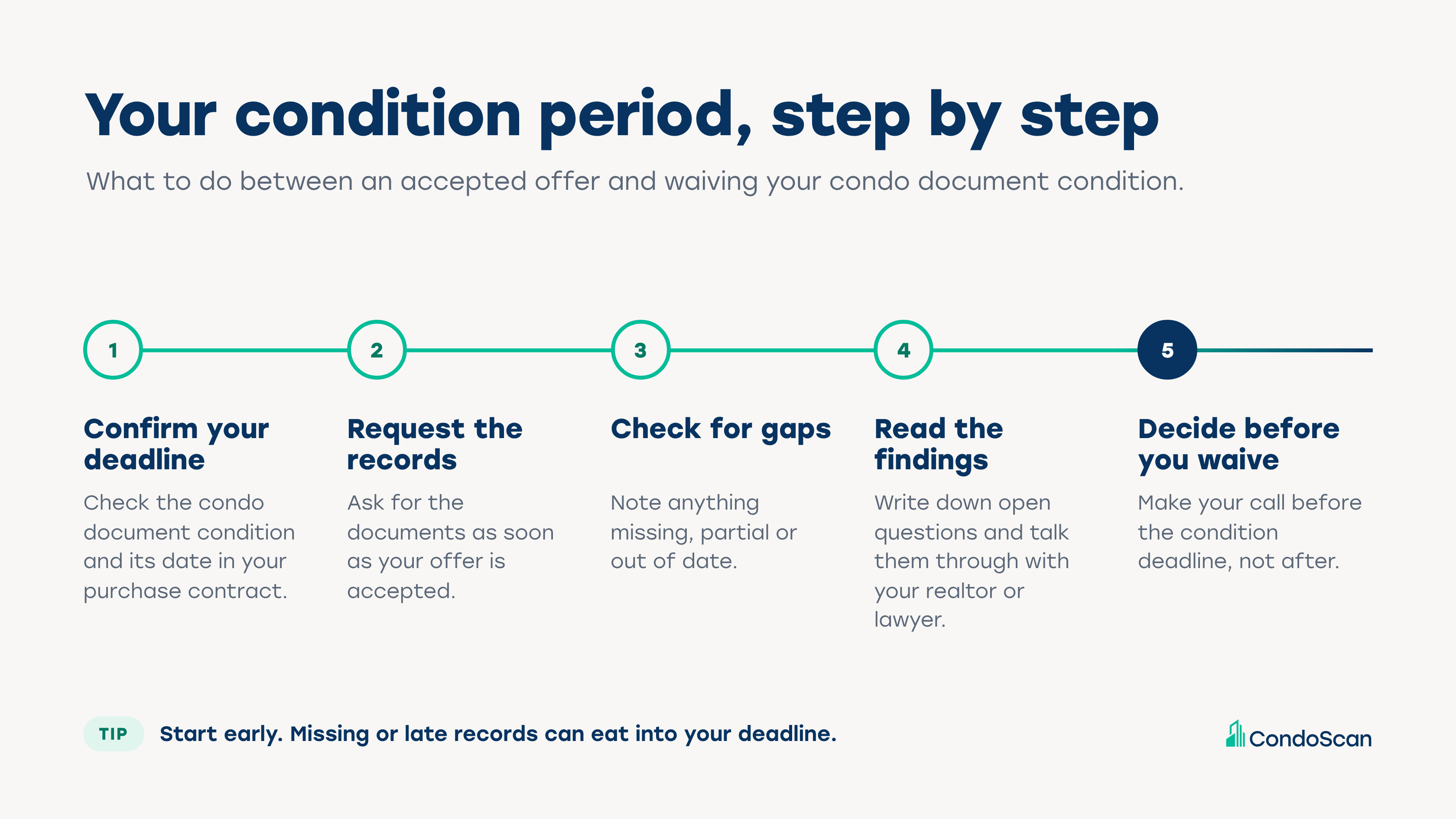
Your realtor and lawyer should guide you on the contract deadlines and what it legally means to satisfy or waive a condition.
How much does a condo document review cost in Alberta?
Prices vary with the provider, property type, scope, turnaround and how much support you get.
As of October 2026, CondoScan's pricing page lists its standard residential review at $349 plus GST. The listed service includes:
- A full document review by a condo expert
- Financial and reserve fund risk analysis
- Document collection support
- A personalized interactive report and PDF
- An audio version of the report
- A one-on-one call to discuss the findings
- 24-hour turnaround after complete documents are received
CondoScan also does not charge a rush fee. For current pricing, check the live pricing page rather than an older article or search result.
But price is only part of the picture. Ask any reviewer:
- What documents are included in the review?
- Does the reviewer analyze finances and reserve funding?
- Is the report personalized to the unit and buyer?
- Can the buyer speak directly with the reviewer?
- Is document collection support included?
- When does the turnaround period begin?
- Are rush charges or other fees added?
- How are missing or inconsistent records handled?
What happens if condo documents are missing?
This is where the Question step matters most. A missing document is information too.
A review can be limited when current financial statements, reserve fund records, minutes, insurance information or other key documents are unavailable. It is also harder to judge a concern when the records cover only a short period or contradict each other.
If something is missing:
- Identify the exact document and period required.
- Ask the seller, listing agent or condominium manager whether it can be provided.
- Confirm whether the document exists and when it was last updated.
- Ask the reviewer what cannot be assessed without it.
- Discuss the effect on your purchase condition with your realtor or lawyer.
The Government of Alberta's condominium-document fact sheet explains which records prospective purchasers may request and the response requirements.
Whatever you do, do not assume "no document" means "no issue."
How do you choose an Alberta condo document reviewer?
Cheap and fast are easy to promise. What you really want is someone who explains what the findings mean and is there to answer questions before your deadline.
Ask prospective reviewers:
- What categories of documents do you examine?
- How do you evaluate reserve fund information?
- Do you compare meeting minutes with financial and maintenance records?
- Will the report distinguish confirmed findings from open questions?
- Can I speak with the person who reviewed the documents?
- What happens if important records are missing?
- Is the report written for my unit and circumstances?
- When does your turnaround clock begin?
- What support is available after delivery?
- Can you provide a sample report?
A useful report tells you why a finding matters, not just what each document says.
Does the condo document review process differ between Calgary and Edmonton?
The rules are the same everywhere in Alberta. The buildings are not.
A Calgary buyer looking at a downtown high-rise may run into very different systems and project histories than someone buying a townhouse condo in a surrounding community. The same goes for Edmonton, St. Albert, Sherwood Park and other Alberta markets.
If you are ready to hire a reviewer in a specific city, start here:
This guide covers the process across Alberta and helps you get ready.
Alberta condo document review checklist
This is the Decide step. You have collected the package, compared the records and asked your questions. Before you remove your condo-document condition, confirm that you have:
- Obtained the available condominium records
- Checked whether important documents are missing
- Reviewed the current budget and recent financial statements
- Compared the reserve fund study with the approved reserve fund plan
- Looked for major repairs, deficits or special-assessment discussions
- Reviewed recent board and general-meeting minutes
- Checked the bylaws for restrictions that affect you
- Confirmed parking and storage rights
- Reviewed the corporation's insurance information and deductibles
- Read the estoppel certificate
- Identified outstanding legal, maintenance or governance questions
- Discussed material contractual or legal concerns with your lawyer
- Completed the review before the applicable condition deadline
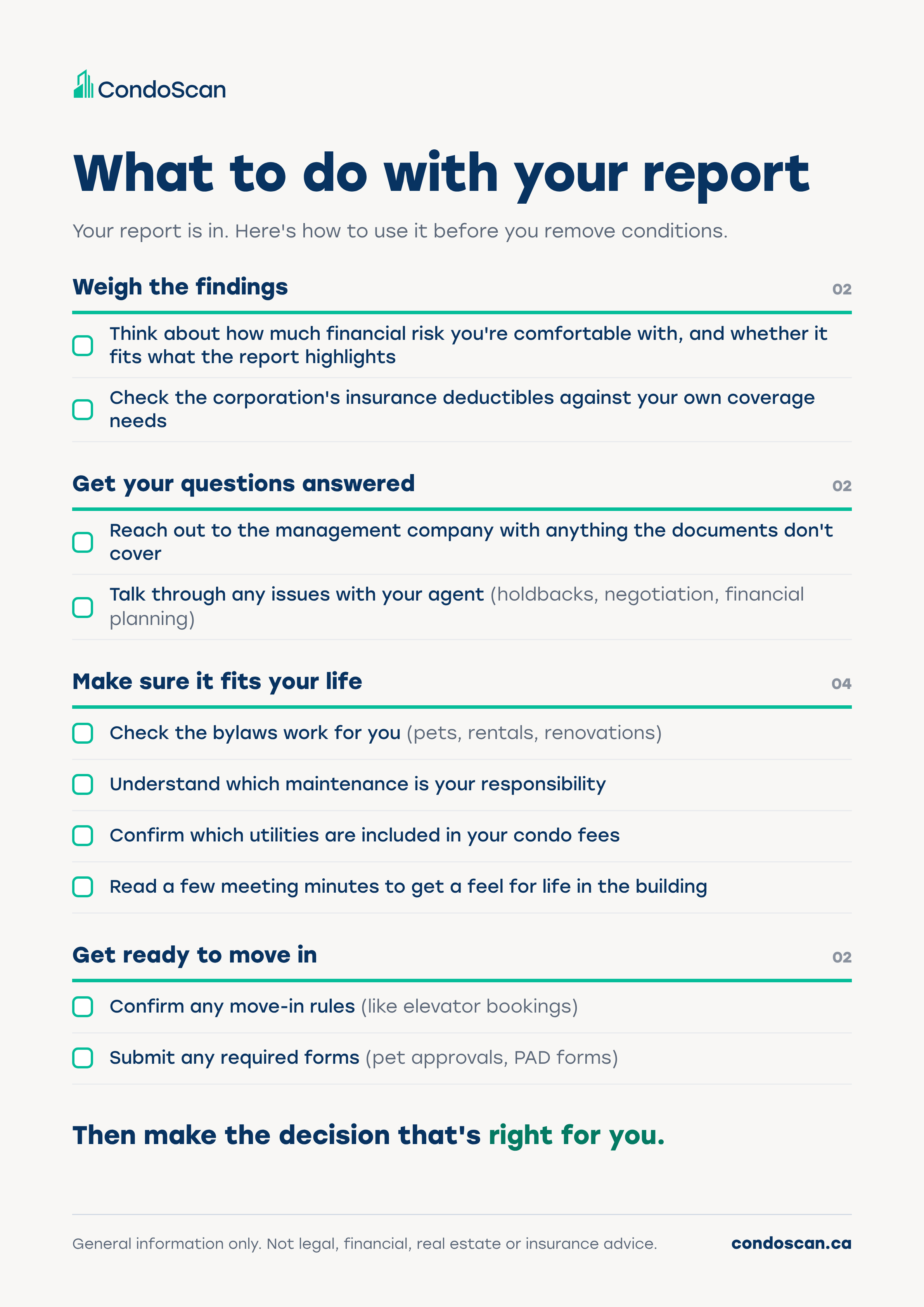
Understand the condo before you remove conditions
The unit is only half of what you are buying. The corporation's finances, reserve planning, insurance, rules and decisions shape both what you pay and what it is like to live there.
The documents are already telling that story. The only question is whether you read it before your conditions come off or after you get the bill.
CondoScan reviews Alberta condo documents, helps collect the records, and gives you a personalized report in plain language. Every standard residential review includes a one-on-one call and 24-hour turnaround after the complete documents are received.
Frequently asked questions
Is a condo document review mandatory in Alberta?
A professional review is not automatically required for every resale condo purchase. However, the Government of Alberta's purchasing guidance emphasizes the buyer's responsibility to obtain and examine the relevant records. It also explains that an offer may be made conditional on obtaining the documents and the purchaser being satisfied with their contents.
Can my realtor review the condo documents for me?
Your realtor can help coordinate the transaction, explain the condition process and obtain records. A dedicated reviewer focuses on analyzing how the financial, reserve fund, maintenance, governance and unit-specific information fits together. Ask your realtor which responsibilities they handle and when they recommend involving a document reviewer or lawyer.
Will a condo document reviewer tell me whether to buy?
A reviewer should explain the findings, risks, limitations and unresolved questions. The final decision belongs to the buyer, with legal, real-estate, financing, inspection or insurance advice obtained where appropriate.
Can a review guarantee there will be no special assessment?
No. A review can identify known assessments, warning signs and funding concerns contained in the available records. It cannot guarantee what a future board decision, repair, insurance event or unexpected condition may produce.
What if my condition deadline is close?
Tell your realtor and reviewer immediately. Confirm which documents have been received, what remains missing and when the review can be completed. Do not assume that a fast review eliminates the need for complete information or professional advice about the purchase contract.
Does a document review replace legal advice?
No. A condo document review is not a substitute for legal advice. Questions involving your purchase contract, title, legal rights, responsibility for an assessment or the interpretation and enforceability of a bylaw should be directed to an Alberta lawyer.
Related reading
July 18, 2026
Reserve Fund Studies in Alberta: What Buyers Need to Know (2026)
The reserve fund study is the single most important document in a condo package, and the hardest to read. Here is what Alberta law requires, how to judge whether a fund is healthy, and the warning signs that a special assessment is coming.

June 12, 2026
The Risks of Reviewing Calgary Condo Documents Yourself
Reading the documents is easy. Interpreting them correctly before your Calgary condition deadline is where most buyers get burned. Here is what DIY reviewers miss, and what it costs.

August 17, 2025
Special Assessments in Calgary Condos: What Buyers Need to Know
A special levy can add thousands to your costs after you move in. Here is why they happen, and how to spot the warning signs before you buy.